Bangladesh garment factory audit checklist: what buyers should verify
A Bangladesh garment factory audit should answer a practical question before an apparel buyer approves a production site: does the factory have the systems, working conditions, safety controls, environmental practices and documentation needed to support the buyer's program responsibly? The answer should come from evidence at the actual production site, not only from a company profile, certificate PDF or sales presentation.
For European apparel buyers, sourcing managers and brand owners, the audit should combine document review, management interviews, worker interviews where appropriate, and physical observation of the facility. Social audit systems such as SMETA examine labour, health and safety, environment and business ethics, while WRAP and amfori BSCI use their own compliance frameworks and assessment systems. These schemes are useful evidence, but buyers still need to understand the findings, corrective actions and exact site covered by the assessment.
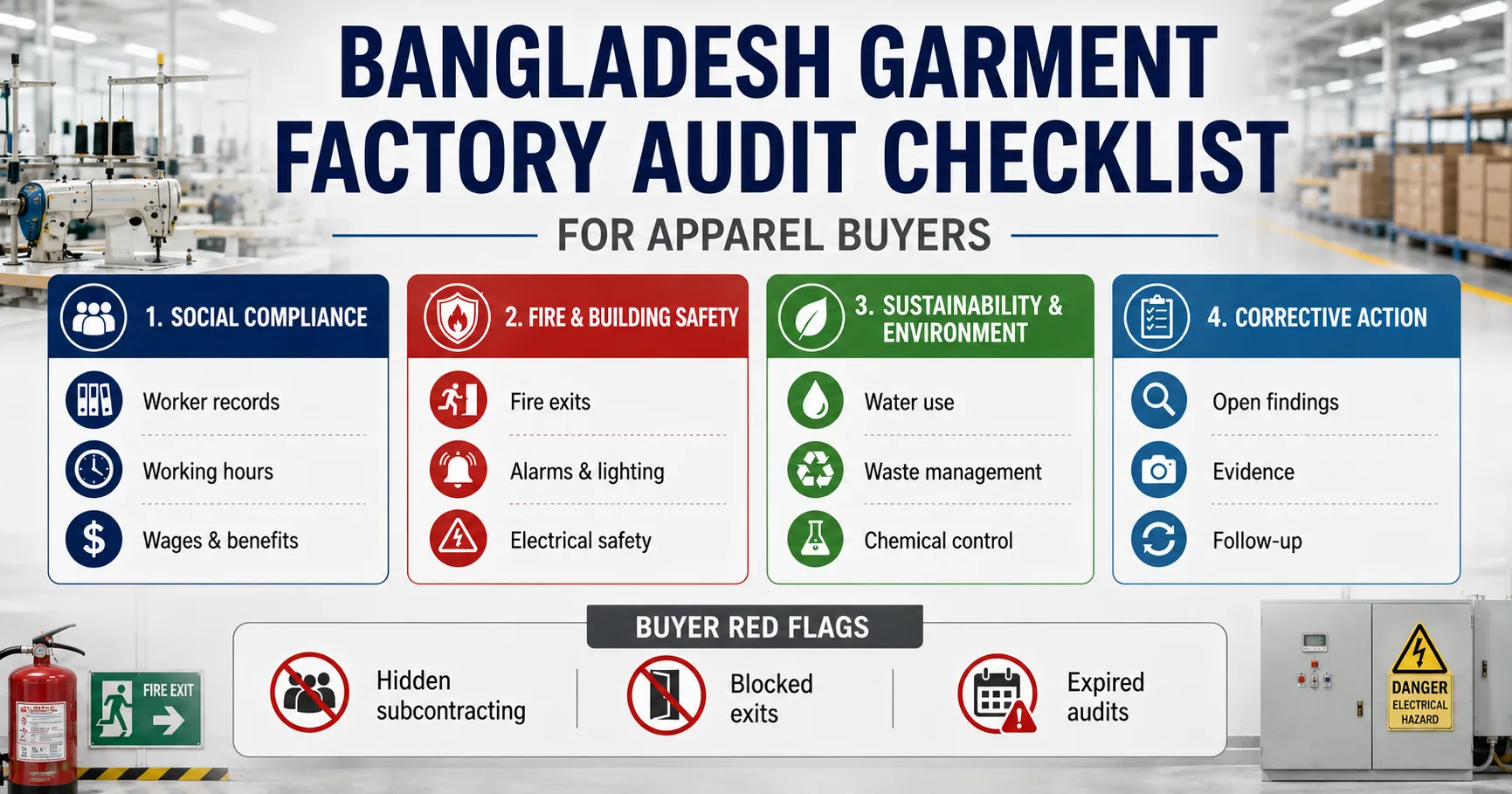
This checklist concentrates on social compliance, fire and building safety, sustainability and environmental controls. Product quality inspection, AQL sampling and pre-production approvals are separate controls. Buyers looking at those areas can use the AQL garment inspection guide and pre-production approval checklist.
The garment factory audit checklist
A useful audit goes beyond asking whether a factory is "compliant." Each question should lead to evidence that can be checked.
| Audit area | What the buyer should check | Evidence to review | Buyer action |
|---|---|---|---|
| Factory identity | Confirm the legal entity and exact production address | Registration records, factory licence, audit reports, site details | Make sure all documents refer to the facility that will actually make the order |
| Approved production site | Confirm whether cutting, sewing, finishing, washing, printing or other processes will take place elsewhere | Production flow, subcontractor list, supplier declarations | Require disclosure and approval of subcontracting |
| Social audit status | Identify the audit framework required by the buyer | Current audit report, findings and corrective action plan | Read the report, not only the rating or logo |
| Employment records | Check that employment documentation is maintained consistently | Contracts, age records, attendance, payroll and leave records | Investigate inconsistencies between records |
| Working hours | Compare recorded hours with factory operations and worker evidence | Attendance, overtime and payroll records | Look for unexplained differences or duplicate records |
| Wages and benefits | Verify that payroll records support the factory's stated practices | Wage sheets, payment evidence, overtime calculations | Escalate missing or inconsistent records |
| Worker voice | Review grievance handling and communication channels | Grievance records, worker committees, policies, interview evidence | Check whether workers can raise concerns without retaliation |
| Fire safety | Inspect escape routes, emergency systems and fire controls | Inspection records, evacuation plans, drill records and corrective actions | Physically verify critical controls during the visit |
| Electrical and structural safety | Check applicable safety inspection and remediation status | Safety reports, remediation records and current status | Verify outstanding findings before approval |
| Occupational safety | Review machine safety, PPE, first aid, ventilation and workplace hazards | Risk assessments, incident records, training records | Check whether controls are actually used on the floor |
| Environmental permits | Confirm permits relevant to the activities performed at the site | Environmental clearance and related approvals | Match the permit scope to actual factory processes |
| Wastewater and water | For wet processing, review treatment and discharge management | ETP records where applicable, testing, water records | Confirm systems are operating, not simply installed |
| Chemical management | Check storage, identification, handling and restricted chemical controls | Chemical inventory, SDS records, storage procedures | Inspect chemical areas physically |
| Waste management | Review segregation, storage and disposal practices | Waste records, hazardous waste controls, disposal evidence | Trace selected waste streams from generation to disposal |
| Energy and emissions | Determine whether the factory records major resource use and environmental impacts | Energy, fuel, water and emissions records where applicable | Compare reporting with the buyer's sustainability requirements |
| Corrective actions | Check whether earlier findings were resolved | CAPs, closure evidence, follow-up reports | Do not treat an old audit as sufficient if serious findings remain open |
The checklist should be adapted to the process. A cut-and-sew garment unit does not have the same environmental profile as a dyeing, washing or wet-processing facility. The buyer should therefore audit what the site actually does, rather than applying identical questions mechanically to every supplier.
Social compliance: look behind the audit report
Social compliance assessment should establish whether the factory's documented policies are reflected in everyday working conditions.
A buyer should review employment practices, working hours, wages, freedom of association, grievance mechanisms, discrimination controls, child labour prevention, forced labour prevention, health and safety and management systems. These subjects are reflected across recognised social audit approaches. Sedex states that a full SMETA audit covers labour, health and safety, environment and business ethics and assesses sites against the ETI Base Code, ILO standards and local law. WRAP's 12 Principles likewise cover workplace practices, health and safety, environmental practices and legal compliance.
Documents alone are not enough. Auditors should look for consistency between attendance records, payroll, production activity and what workers say about actual conditions. A clean policy manual has little value if working-hour records, grievance practices or safety behaviour tell a different story.
Buyers should also use the correct terminology. SMETA is an audit methodology, not a certification, and Sedex explicitly states that it does not issue a pass or fail through the methodology. WRAP, by contrast, operates a facility certification program and requires corrective actions to be implemented and verified before certification is granted. amfori BSCI has its own monitoring and rating system. These systems should not be casually treated as interchangeable.
For a deeper comparison of these systems, use the separate BSCI vs WRAP vs SEDEX guide. This audit checklist should remain focused on what the buyer verifies at factory level.
Fire, building and occupational safety checks
Factory safety in Bangladesh requires more than seeing fire extinguishers during a tour. Buyers should examine the condition of escape routes, fire doors, alarms, emergency lighting, electrical installations, evacuation procedures, structural issues and other safety systems relevant to the site.
Under the Bangladesh Safety Agreement, factories covered by the program participate in safety activities implemented by the RMG Sustainability Council. The program includes fire, electrical, structural and boiler safety inspections, remediation monitoring, safety training and a health and safety complaints mechanism. The RSC also publishes factory information that can show remediation status for covered facilities.
A buyer auditing an RSC-covered factory should therefore check the current status, not merely ask whether the factory has ever been inspected. Outstanding remediation findings, delayed corrective action or an ineligible status can materially change the sourcing decision.
On the factory floor, check whether exits are accessible during normal production, evacuation routes are clearly usable, electrical panels are maintained safely, materials are not stored in ways that create unnecessary hazards, machine guards are in place, first-aid arrangements are accessible and workers understand emergency procedures.
Safety should also be managed as an ongoing system. The ILO's work in Bangladesh emphasises occupational safety and health systems, labour inspection and worker participation rather than treating workplace safety as a one-time exercise.
Sustainability and environmental controls
A sustainability review should distinguish between environmental claims and environmental management evidence.
Start with the processes carried out at the site. Sewing and packing create a different environmental risk profile from dyeing, printing, garment washing or other wet processes. Ask which operations consume significant water, energy or chemicals and which generate wastewater, emissions or hazardous waste.
For relevant facilities, buyers should examine:
- Environmental clearance and permits applicable to the site.
- Water consumption and wastewater management.
- Effluent treatment controls where wet processing requires them.
- Chemical inventories and safety data sheets.
- Chemical storage, labelling and spill response.
- Waste segregation and disposal records.
- Controls for hazardous waste.
- Energy and fuel consumption records.
- Air emissions or other environmental monitoring relevant to the process.
- Environmental incidents, complaints and corrective actions.
- Environmental requirements applied to subcontractors.
Bangladesh's Department of Environment maintains the country's environmental clearance system and services relating to environmental approvals, including ETP and STP design approval. The Environment Conservation Rules 2023 are part of the current regulatory framework. Buyers should still confirm which approvals apply to the particular factory and production process instead of assuming that every garment facility has identical requirements.
International textile standards provide useful reference points as well. Sedex's environmental assessment covers areas including chemicals, energy, waste, water and environmental permits. OEKO-TEX STeP evaluates facility-level environmental and chemical management alongside social responsibility, health and safety and quality management.
Be careful not to confuse product testing with facility sustainability. OEKO-TEX STANDARD 100 concerns textiles tested for harmful substances. It is not, by itself, proof that a production facility meets broader social or environmental management requirements. OEKO-TEX STeP is the facility-oriented standard in that system.
If an order involves organic or recycled claims, verify the certification scope and chain-of-custody documents relevant to that specific supply chain. GOTS uses independent third-party certification and on-site inspection across textile processing and trading, while the Global Recycled Standard includes recycled material verification, chain of custody and additional social, environmental and chemical requirements.
Milky Fashions does not own the factories it works with and does not itself hold factory certifications such as BSCI, GOTS or OEKO-TEX. When those requirements apply, the relevant documents must belong to and be verified against the actual partner factory or supply-chain entity involved.
Red flags and corrective action follow-up
A factory does not need to be perfect to demonstrate a functioning compliance system. What matters is whether risks are disclosed, investigated and corrected. A factory that openly documents a problem and closes it properly may be a safer sourcing choice than one that produces polished paperwork but cannot explain what happens when a problem occurs.
Buyer red-flag checklist
- The legal entity or address on an audit report does not match the proposed production site.
- Management will show a certificate but refuses to share the underlying audit findings when the buyer is entitled to review them.
- A social audit is presented as current, but significant corrective actions remain unresolved.
- Production processes or subcontractors appear during the visit that were not disclosed before the audit.
- Workers, attendance records and payroll records give materially different pictures of working hours.
- Emergency exits are obstructed, locked or difficult to access during production.
- Fire, electrical or structural remediation issues are known but their current status cannot be demonstrated.
- Chemical containers are unidentified or chemical storage is uncontrolled.
- A wet-processing facility cannot explain how wastewater is treated or monitored.
- Environmental permits do not appear to match the actual processes taking place.
- Waste disposal cannot be traced to documented handling or disposal routes.
- Management becomes defensive when asked about worker grievances, incidents or corrective actions.
- A sustainability claim relies only on logos without scope, validity or supply-chain evidence.
After the audit, classify findings by severity and assign an owner, corrective action, evidence requirement and closure status. Serious worker-safety, labour-rights or environmental findings should be resolved before production approval where they create unacceptable risk. Lower-level observations can be tracked through an agreed improvement plan when appropriate.
A factory audit should also connect with the buyer's wider supplier assessment. Commercial performance, product capability and delivery reliability belong in a broader Bangladesh garment supplier scorecard, rather than being mixed into a social and environmental audit.
Caveat: no factory audit can guarantee future compliance, product quality or uninterrupted production. An audit is evidence from a defined site and period. Conditions can change, which is why corrective-action follow-up, ongoing supplier management and appropriate product inspections remain necessary.
Frequently asked questions
What should be included in a Bangladesh garment factory audit?
At minimum, the audit should verify the exact production site, social compliance systems, employment and working-hour records, worker health and safety, fire and building safety status, environmental permits, wastewater and chemical controls where relevant, waste management, subcontracting transparency and corrective-action history. The scope should then be adjusted to the product and processes involved.
Is a BSCI, SMETA or WRAP audit enough to approve a garment factory?
Not automatically. These systems provide valuable third-party evidence, but the buyer should confirm which system its own compliance policy accepts, verify that the correct production site is covered, review findings and corrective actions and check whether conditions observed at the factory remain consistent with the documentation. SMETA should also not be described as a certification.
How can a buyer verify fire and building safety in a Bangladesh factory?
For factories covered by the Bangladesh Safety Agreement, buyers can review available RSC information and the factory's current remediation position, then verify relevant safety conditions during the site audit. Physical checks should include emergency access, fire controls, electrical conditions and other hazards relevant to the facility.
What environmental documents should an apparel buyer request?
The exact documents depend on what the factory does. Buyers should request environmental clearance or permits applicable to the site and, for processes involving significant water, chemicals or effluent, relevant treatment, monitoring and disposal records. Chemical inventories, waste records, energy and water data and corrective-action records can also provide evidence of how environmental controls operate in practice.
Should buyers audit a factory again after approval?
Supplier oversight should be risk-based rather than treated as a one-time approval. New processes, subcontracting, significant compliance findings, expired assessments, major facility changes or unresolved corrective actions can all justify further review. Buyers should also follow any audit frequency required by their own compliance program or chosen assessment framework.
For European brands evaluating production in Bangladesh, Milky Fashions can support factory identification, documentation coordination and buyer-side sourcing follow-up through its independent partner-factory network in Dhaka, Bangladesh. Contact us by WhatsApp or email to discuss your product brief and compliance requirements.
Sources
- Sedex, SMETA methodology and four-pillar audit scope.
- WRAP, 12 Principles and facility certification process.
- amfori, BSCI monitoring and audit methodology guidance.
- International Accord and RMG Sustainability Council, Bangladesh factory safety and remediation.
- International Labour Organization, occupational safety and labour systems in Bangladesh.
- Bangladesh Department of Environment, Environment Conservation Rules and environmental clearance services.
- Global Organic Textile Standard and Textile Exchange, certification and chain-of-custody requirements.
- OEKO-TEX, STANDARD 100 and STeP scope.
Ready to discuss a sourcing brief?
Share your product family, sample status, and market destination. We will help you prepare the next conversation around the details you provide.
Discuss your sourcing brief on WhatsApp