
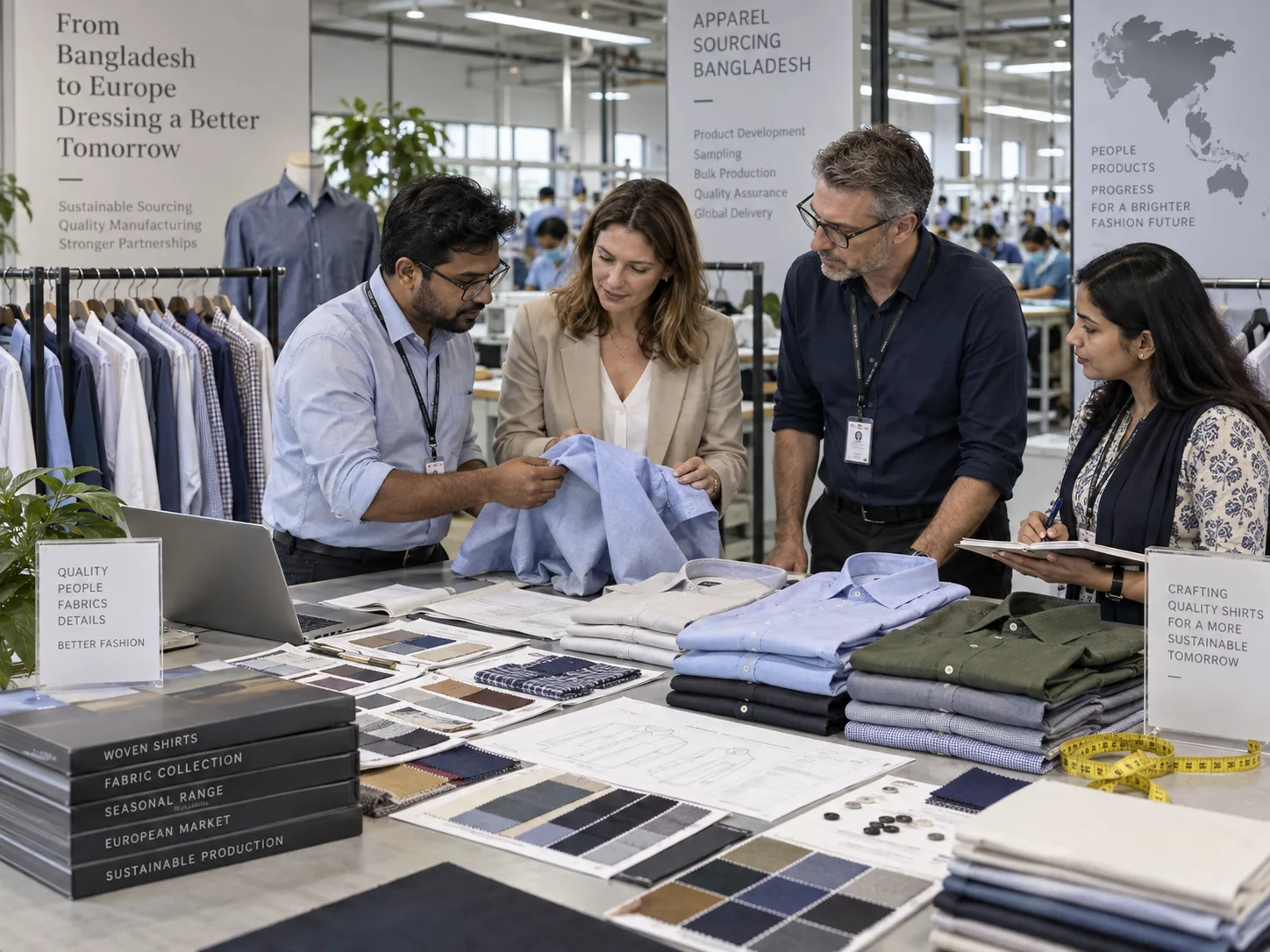
Woven shirt sourcing in Bangladesh requires agreement on fabric, fit and finishing before a production quotation becomes useful. Milky Fashions supports European and UK brands, importers and wholesale buyers developing men's and women's woven shirts through partner factories. Based in Dhaka and working since 2002, we coordinate product development, sampling, production follow-up, quality checks and shipment preparation around the buyer's brief.
Whether your collection calls for cotton Oxford shirts, a crisp poplin style or a relaxed linen-blend silhouette, the starting point is the product you need to sell. Our role is to organise the sourcing work and keep specifications, decisions and approvals connected. You retain product approval through our sourcing model, with factory suitability assessed against the actual shirt programme.
Define the shirt collection before choosing a production route
A useful shirt brief identifies the wearer, intended use and retail positioning. A fitted business shirt, an oversized women's shirt and a casual button-down may share a fabric description while requiring different patterns, interlinings, sewing operations and finishing. Establish which details define the product before discussing alternatives that could affect its appearance or cost.
For men's shirts, describe the intended body shape, collar style, sleeve length, cuff construction and whether the shirt will usually be tucked in. For women's shirts, include bust shaping, shoulder position, armhole comfort, front closure coverage and the intended relationship between body width and length. Fit should follow your brand's approved measurements and customer profile.
Separate essential design requirements from preferences. A particular collar roll or concealed placket may be essential to the collection. A button supplier or packaging detail might allow alternatives, subject to approval. Recording that distinction helps the sourcing team investigate practical options without changing the design by assumption.
For private label and OEM programmes, identify ownership of patterns, artwork, labels and sample approvals. Explain whether the order is a new development, an adaptation of an existing block or a repeat style. If it is a repeat, provide the previous approved sample and describe any changes in fabric, wash or sizing.
We use this information to coordinate the development discussion with relevant production partners. An initial enquiry can begin with reference photographs, but quoting and production decisions need progressively clearer specifications. Record unresolved points so the factory and buyer understand what remains provisional.
Select shirting fabrics against appearance and performance
Fabric selection should connect the desired shirt appearance with measurable requirements. Specify composition, weave, weight, colour, finish and the approved hand feel. CottonWorks describes Oxford as a basket-derived construction and twill by its diagonal weave pattern, illustrating why a generic request for cotton fabric leaves important choices open. CottonWorks fabric construction guidance.
The following routes are starting points for a sourcing discussion. Availability and suitability need confirmation against the individual brief.
| Fabric or design route | Collection direction to discuss | Approval checks to prioritise |
|---|---|---|
| Cotton poplin | Clean, crisp shirts and structured silhouettes | Opacity, surface appearance, seam smoothness and finished measurements |
| Cotton Oxford | Textured button-down and casual shirt programmes | Fabric handle, collar roll, seam bulk and appearance after washing |
| Cotton twill | Shirts where a visible diagonal texture supports the design | Drape, surface character, shade consistency and finishing response |
| Linen and cotton blends | Relaxed seasonal shirts with a textured appearance | Agreed natural irregularities, creasing, shrinkage and colour variation |
| Viscose or lyocell woven fabrics | Fluid women's shirts and softer silhouettes | Drape, opacity, dimensional stability and seam performance |
| Yarn-dyed stripes or checks | Pattern-led men's and women's shirts | Repeat size, colour approval and matching at specified garment positions |
For a white or pale shirt, review opacity in the assembled garment, including the front placket and pocket area. A swatch on a desk cannot resolve every question about the finished shirt. For patterned fabrics, mark which seams and components must match, including pockets, centre fronts or yokes. Have the factory account for those requirements when assessing fabric consumption.
Define the finish through an approved sample. Requests such as soft wash, easy care or wrinkle resistance need a clear reference and suitable verification. Avoid approving a finish solely from a photograph or a marketing description. If a finish changes during development, review its effect on measurements, shade, handle and labelling before carrying the change into bulk production.
Develop fit and samples with clear approval ownership
Shirt sampling should answer specific questions at each stage. A development sample may establish construction, a fit sample may resolve proportions, and a pre-production sample should represent the agreed production specification. Identify the purpose of each submission so approval of one feature is not mistaken for approval of the complete garment.
Milky Fashions coordinates garment sample development with the buyer and production partner. Provide the measurement chart, construction drawings, tolerances and bill of materials through your garment tech pack. Where information is missing, identify what must be supplied or agreed before the next sample stage.
Evaluate shirts both on the body and against measurements. Check collar comfort when fastened, movement across the shoulders, sleeve rotation, cuff opening and the front placket when the wearer sits or reaches. For women's styles, assess closure gaping and the position of darts or other shaping. For oversized styles, record the intended ease so it remains controlled during grading.
Review the garment after the agreed care process as well as before it. Record changes in dimensions, collar and cuff appearance, seam smoothness and colour. Ask the technical team to investigate the cause of an unacceptable result before adjusting the pattern or approving a substitute material.
Keep sample comments consolidated under a named buyer approver. Each revision should identify the style, sample version, required correction and approval status. Use the pre-production approval checklist to connect the final shirt sample with approved fabric, trims, artwork and packaging. Any departure from those approvals during production should be recorded and referred for a decision.
Match factory capability and compare complete quotations
The proposed production partner should be assessed against the shirt's construction and finish. Relevant questions include experience with comparable fabrics, collar and cuff assembly, pattern matching, pressing and the specific wash or treatment required. Establish which operations will take place at the nominated facility and whether any specialist processing will involve another unit.
Milky Fashions does not own factories. We coordinate sourcing through partner factories and organise the technical and commercial discussion around your requirements. The proposed facility, production arrangement and supporting documentation need review for the programme concerned.
Ask for a quotation that identifies its assumptions. It should reference the style specification, fabric quality, colour breakdown, size range, trims, packaging and agreed delivery basis. Clarify the treatment of sampling, testing, specialist finishing and sourcing or coordination charges. Compare quotations using the same approved requirements and make exclusions visible.
For woven shirts, discuss the manufacturing cost drivers created by fabric consumption, pattern matching, construction details and finishing. If the price needs adjustment, request defined alternatives. Changing the fabric, removing a pocket or simplifying the packaging are different decisions with different product consequences. Each needs buyer approval.
Build the schedule around material availability and approval milestones. Separate sample work, bulk fabric preparation, garment production, testing, inspection and transport. Your required warehouse date should be considered alongside those stages. Our lead-time planning guidance explains the wider process; the shirt programme needs its own dated schedule and responsibilities.
Set quality checkpoints for the finished woven shirt
Translate the approved sample into inspection criteria that factory and buyer teams can apply consistently. Collar shape, cuff symmetry, placket alignment, pocket position and hem appearance should be assessed alongside measurements and stitching. Pattern matching requirements need defined locations and acceptable variation, supported by photographs where useful.
Pay attention to seam appearance during development and early production. Coats identifies fabric structure, seam construction, thread and needle selection, tension and feeding as contributors to seam puckering. Its guidance also explains why some problems become visible after washing. This supports checking the complete fabric and sewing combination before repeating it across an order. Coats seam puckering guidance.
Agree a test plan with the buyer and laboratory for the actual materials and shirt design. Relevant checks may include dimensional stability, colourfastness, seam performance, button attachment and the appearance of fused collars or cuffs after care. Record the test method and acceptance criteria before results are needed for shipment approval.
During production, review early garments for recurring construction issues and compare subsequent output with the approved standard. Record shade groups where relevant and check that panels, trims and packaging remain aligned with the order specification. Corrective action should identify the issue, affected goods, action taken and how the result will be checked.
Final inspection provides an assessment of the submitted shipment under the agreed inspection plan. Define defect classifications and acceptance criteria before inspection; our AQL inspection guide explains the terminology. Keep laboratory testing, measurement checks and inspection findings connected when deciding whether the shipment is ready for buyer approval.
Prepare evidence for the markets where the shirts will be sold
State the intended countries of sale when briefing the order. A European collection may be distributed across EU countries and the UK, with market-specific requirements affecting labels, product information and supporting evidence. Confirm the destination list before approving artwork and packaging.
Textile fibre composition needs accurate labelling. For EU distribution, check the language requirements of the countries where the shirts will be offered. For Great Britain, confirm the applicable label wording with the importer. Use the official EU textile labelling guidance and Great Britain textile labelling guidance during approval. Identify Northern Ireland separately in the market brief. Agree care instructions against the finished garment's assessed performance.
The EU General Product Safety Regulation has applied since 13 December 2024. UK government guidance confirms its application in Northern Ireland from the same date and distinguishes the framework applying in Great Britain. Establish the relevant product identification, responsible business details and safety documentation with your importer. European Commission GPSR guidance, UK guidance for Northern Ireland.
Agree the chemical testing scope for the selected fabric, dyes, prints, interlinings, trims and finishes. The buyer's restricted substances requirements should be supplied early enough to inform material selection. Our REACH and OEKO-TEX guidance provides background for that discussion.
Where an organic or certified-product claim is requested, check the relevant certificate scope, validity and order documentation. OEKO-TEX provides an official Label Check; GOTS explains supply-chain certification and transaction documentation through its certification resources. Milky Fashions coordinates evidence from production partners and does not hold factory or product certificates as its own. Review the factory certification guidance when specifying the evidence your buying team requires.
Send a woven shirt brief for a sourcing review
To begin a woven shirt sourcing discussion, send the collection outline and the information already approved. A complete technical pack is useful, but an early enquiry can also identify development gaps and the next decisions needed. Make clear which details are fixed and which you want reviewed.
Your brief should include:
- Brand or company name, contact person and intended European or UK sales markets.
- Men's or women's styles, reference images and intended fit.
- Fabric composition, construction, weight, finish and any available swatches.
- Style quantities, colour breakdown and proposed size range.
- Construction details, branding, packaging and testing requirements.
- Required delivery date, destination and preferred commercial delivery basis.
- Current sample status, outstanding questions and the person responsible for approvals.
For repeat shirts, include the previous approved sample, specification and changes required for the new order. For new developments, highlight the features that matter most to the collection, such as collar shape, fabric handle or pattern matching. This gives the sourcing discussion a clear starting point.
Through our garment sourcing services, Milky Fashions coordinates the review of product requirements, factory options, samples and production preparation. Share your woven shirt brief on WhatsApp so we can identify the information needed for the next sourcing decision.
Frequently asked questions
Can Milky Fashions source both men's and women's woven shirts?
Milky Fashions coordinates sourcing enquiries for men's and women's woven shirts through partner factories in Bangladesh. The proposed production route depends on the fabric, fit, construction, order breakdown and buyer requirements. Milky Fashions is an independent sourcing partner and buying house, and does not own the factories.
Which fabrics can I specify for woven shirt sourcing?
Your brief can identify cotton poplin, Oxford, twill, linen blends or other woven shirting fabrics, with reference swatches where available. Specify composition, weight, colour, finish and performance expectations. Material availability and suitability must be confirmed for the individual programme before a fabric route is agreed.
What is the minimum order quantity for woven shirts from Bangladesh?
There is no universal MOQ that can be confirmed without reviewing the order. Fabric production or availability, colour quantities, trims, garment construction and the proposed factory all affect feasibility. Send the quantities by style and colour so the sourcing review can establish realistic options and their conditions.
Can I request shirt samples before bulk production?
Sampling is part of the development and approval discussion. Milky Fashions coordinates sample requirements with the buyer and production partner, including the purpose of each submission and the information needed to proceed. Sample costs, material arrangements and timing must be agreed for the actual shirt brief.
How long does woven shirt production in Bangladesh take?
Timing depends on material availability, sample approvals, fabric preparation, garment construction, testing and the production schedule. Shipment timing also depends on transport arrangements and destination. A useful programme separates these stages and records buyer approval deadlines before a delivery commitment is confirmed.
Can I request GOTS or OEKO-TEX certification for woven shirts?
Certification requirements can be included in the sourcing brief. They must be assessed against the proposed materials, relevant production stages, certificate scope and order documentation. Availability is confirmed for the specific programme. Milky Fashions coordinates evidence with production partners and does not claim these certificates as its own.
What information is needed to request a woven shirt quotation?
Provide the style references or tech pack, fabric specification, colour and size breakdown, quantities, construction details, branding, packaging and testing requirements. Include the intended sales markets, required delivery date and preferred commercial delivery basis. Identify any unapproved details so quotation assumptions can be stated clearly.
Ready to discuss a sourcing brief?
For fashion brands, importers, and wholesale buyers. Share your product family, sample status, and market destination so we can prepare the next conversation.
Discuss your sourcing brief on WhatsApp