
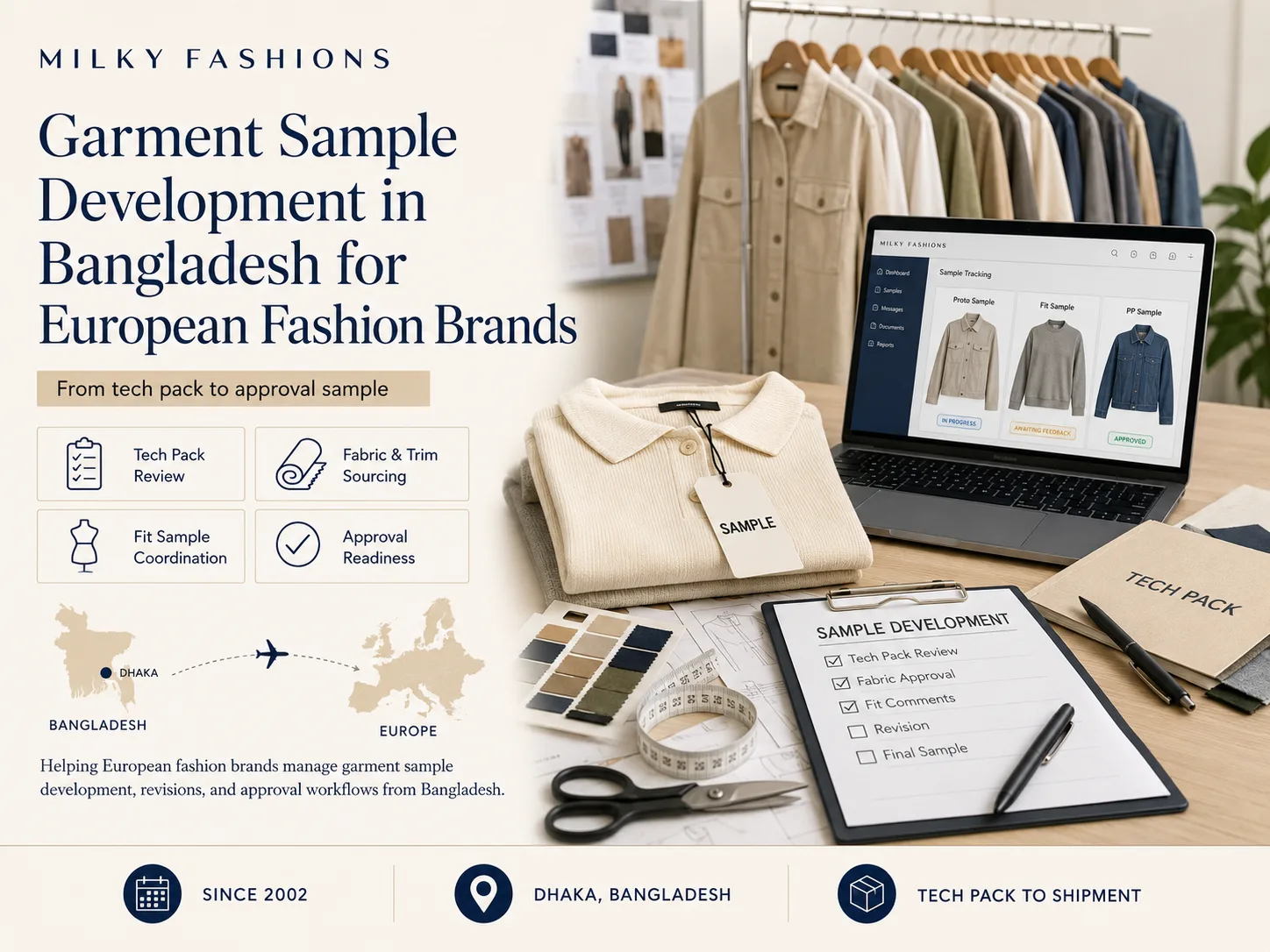
Garment sample development for European fashion brands
Garment sample development in Bangladesh should do more than produce a physical garment. For a European fashion brand, the sampling stage should convert a design, tech pack or reference sample into a product that can be assessed for construction, fit, measurements, fabric, trims, decoration and production feasibility before bulk decisions are released.
Milky Fashions is an independent apparel sourcing partner and garment buying house based in Dhaka, working since 2002. We do not own factories. We coordinate sample development through partner factories selected for the actual product brief. For fashion teams in France, Spain and Germany, this provides one Bangladesh-side coordination point for technical questions, sample comments, material approvals and the handoff from development into bulk production.
What a good sample program should solve before bulk
Sampling is the point where assumptions become visible. A sketch may look clear, but the first garment can expose questions about seam construction, balance, shrinkage, collar shape, pocket placement, grading, print position, trim quality or how the selected fabric behaves after finishing.
A disciplined apparel sample development process should therefore answer a short list of practical questions before the order moves forward:
- Does the construction match the intended design?
- Are the measurements and proportions workable?
- Is the chosen fabric or yarn suitable for the silhouette and end use?
- Do trims, labels, prints, embroidery and washes match the brief?
- Can the pattern be corrected and graded consistently?
- Are buyer comments being applied to the current version?
- Is the approved sample clear enough to become a production reference?
This matters across different product families. A jersey T-shirt, heavyweight hoodie, woven shirt, washed denim style and flat knit cardigan do not follow the same technical development route. Fabric behaviour, pattern work, wash effects, knit structure, machinery and finishing can all change the sampling requirements.
Milky Fashions therefore starts by matching the sample brief to an appropriate partner factory or development route. The aim is not to send every style to whichever factory is available. It is to develop the sample in a setting that is relevant to the intended bulk product.
Speed matters in garment sampling Bangladesh, but it should not replace accuracy. A sample with unresolved measurements, substitute materials or unclear comments can create another revision rather than move the product closer to bulk.
Sample stages from proto to pre-production approval
Not every buyer uses identical terminology, and not every style needs every sample type. The sequence should be agreed at the start of the program. The following stages are common in garment sampling and prototyping for export apparel.
| Sample stage | Main purpose | What the buyer should review |
|---|---|---|
| Development or proto sample | Translate the initial design or tech pack into a first physical garment | Construction, silhouette, proportions, design details and initial feasibility |
| Fit sample | Refine fit and measurements against the buyer specification | Balance, measurements, ease, length, shape and pattern corrections |
| Size set sample | Check how the approved fit grades across selected sizes | Grading, key measurements, proportions and size consistency |
| Salesman or showroom sample | Support range presentation, selling or internal commercial review when requested | Appearance, colour, fabric direction, branding and presentation |
| Photo sample | Support photography or content requirements when separately requested | Visual appearance, colour, styling details and sample condition |
| Pre-production sample or PP sample | Establish the final approved product before bulk starts | Bulk fabric or agreed material, trims, construction, measurements, branding and finish |
| TOP or production sample | Compare early bulk production with the approved standard when required | Consistency with PP approval and current specifications |
| Shipment or reference sample | Retain a finished reference from the completed order when required | Finished garment, packing and final order reference |
The proto sample is usually where the first interpretation of the design becomes tangible. It is a development tool, not automatically the final commercial standard. If the initial sample reveals a fit, construction or material issue, that issue should be corrected in the next controlled round.
The fit sample should focus on the garment's measurements, balance and intended silhouette. Buyer comments need to be specific. “Make it better fitted” is less useful than a revised measurement, annotated photo or clear construction instruction. When a pattern changes, connected measurements should also be reviewed rather than adjusting one point in isolation.
A size set sample checks whether the fit logic works beyond the base size. This is where pattern grading becomes important. A base-size approval does not automatically prove that smaller and larger sizes preserve the intended proportion.
The pre-production sample is the critical handoff point. The objective is to create a clear approved reference using the correct or agreed production materials, trims, branding and construction before bulk begins. It should align with the latest approved specification and comments.
Milky Fashions can coordinate these stages according to the buyer's own approval process. We do not impose one universal sample sequence where the brand already has established technical procedures.
What to send before sample development starts
The fastest route to a useful sample is a clear brief. A buyer can begin with a tech pack, an existing garment, sketches or a design concept, but the amount of interpretation required changes with the quality of the input.
For garment sample development Bangladesh enquiries from France, Spain or Germany, useful starting information includes:
- Tech pack or technical drawing where available
- Measurement chart and size range
- Fabric or yarn composition, weight and construction
- Colour references or Pantone direction where applicable
- Artwork for print, embroidery or other decoration
- Trim and accessory requirements
- Main label, care label and branding direction
- Wash, dye or finishing requirements
- Reference garment or reference images if relevant
- Target market and product category
- Intended bulk quantity structure where known
- Required sample type and approval stage
A tech pack does not need to be visually elaborate, but it should remove ambiguity. If a construction detail is critical, identify it. If a measurement has a tolerance, state it. If artwork placement matters, show the position and size. If a trim must match a reference, provide enough information to develop it.
The same applies to fabric and trim sourcing. Sample development in Bangladesh can require available substitute material during an early development round, or it can require exact nominated material, depending on the buyer's objective. The status of the material should be clearly recorded so an early sample is not accidentally treated as a bulk approval standard.
Fabric approvals can include composition, GSM, structure, handfeel, colour, lab dips, wash effect or other buyer-defined parameters. Trim approvals can include zippers, buttons, drawcords, rib, labels, hangtags, packaging or branding components. Print and embroidery may require strike-offs or artwork approvals before the complete garment sample is accepted.
When comments return, one current comment sheet should replace fragmented instructions across multiple email chains. Revision control is a simple discipline, but it prevents old measurements or superseded trim instructions from reappearing in later samples.
Coordinating samples for brands in France, Spain and Germany
European brands often manage product development remotely from the production origin. The main challenge is therefore not distance by itself. It is keeping decisions clear while the physical sample, digital specification and buyer comments move between teams.
For a fashion brand in France, Spain or Germany, Milky Fashions can act as the Dhaka-side sourcing coordinator between the buyer and selected partner factory. The buyer remains responsible for design direction and approvals. Our role is to help translate approved instructions into the development process, follow the sample status and raise technical or material questions that need buyer decisions.
This structure is useful when several sample streams are running at once. A collection might include jersey styles with one production partner, sweaters with another and woven garments with a third. The buyer should not have to lose control of version history because each category follows a different factory route.
A practical sample workflow can look like this:
- Buyer sends the tech pack, reference garment or development brief.
- Milky Fashions reviews the product and identifies a suitable partner-factory route.
- Material, trim and technical questions are clarified before or during development.
- The requested proto, fit or other sample is developed.
- Buyer comments are consolidated and returned against the current specification.
- Pattern, measurement, construction, fabric or trim changes are followed through the next round.
- Size set or other approval samples are developed where required.
- The PP sample and current specification are aligned before bulk release.
Physical samples can be sent to the buyer or nominated destination according to the agreed courier arrangement and buyer instructions.
This page is intentionally narrower than our broader garment sourcing services. It focuses on the commercial sample-development stage. General factory sourcing belongs on our garment sourcing pages, while detailed tech-pack education belongs on the dedicated tech pack guide.
From approved sample to bulk production handoff
A good production-ready sample is valuable because it becomes part of a controlled handoff, not because it looks good in isolation.
Before bulk starts, the factory team should be working from the same approved information as the buyer. That can include the latest tech pack, measurement chart, pattern revision, fabric approval, trim card, artwork approval, colour reference, wash standard, packing instruction and approved PP sample.
The handoff should also identify any approved exceptions. If one trim differs from the original tech pack, or a measurement was changed during fit approval, the production file should show the final decision rather than forcing the sewing line to interpret old comments.
Milky Fashions can coordinate this handoff with the selected partner factory and continue into production follow-up where the buyer appoints us for the wider sourcing program. Sample approval should then connect to pre-production planning, in-line quality checkpoints and the buyer's final inspection requirements.
There is an important caveat. We cannot responsibly promise a universal sample fee, fixed sample turnaround, guaranteed first-round approval or one sampling sequence for every garment. Timing and development effort depend on the style, material availability, trims, wash or decoration, pattern work, buyer comments and the selected partner factory. Exact sample requirements should be agreed after the actual brief is reviewed.
Start with the sample brief
If you are looking for garment sample development in Bangladesh for a fashion brand in France, Spain or Germany, send the product information first.
A complete tech pack is the best starting point when available. If the product is still at an earlier stage, a reference garment, clear sketches, measurement information and material direction can be enough for an initial review.
Milky Fashions can then assess what is missing, identify the appropriate Bangladesh development route and discuss which sample stage should come first. For some styles that will be a proto sample. For others, the buyer may already have an approved base and need a fit sample, size set or pre-production sample.
The objective is to move from concept to an approvable, production-ready garment without losing control of the buyer's current specification.
For the fastest initial discussion, send your tech pack, reference images or sample brief through WhatsApp. Include the product category, target market, required sample type and intended bulk program where known.
Frequently asked questions
What is garment sample development in Bangladesh?
Garment sample development is the process of turning a buyer's tech pack, reference garment, sketch or product brief into physical samples that can be reviewed before bulk production. Depending on the program, this can include proto samples, fit samples, size sets, salesman samples and pre-production samples.
What sample should a European fashion brand develop first?
The correct starting sample depends on how developed the product already is. A new design commonly begins with a development or proto sample. A style with an established construction may move directly into fit development, while an existing approved product may require a size set or another later approval stage.
What is the difference between a proto sample and a fit sample?
A proto sample is an early physical interpretation of the design and is mainly used to assess construction, proportions and overall product direction. A fit sample focuses more closely on measurements, balance, silhouette and pattern corrections against the buyer's fit requirements.
What is a size set sample?
A size set sample is used to check how an approved fit and pattern grade across selected sizes. It helps the buyer review whether key measurements, proportions and garment shape remain consistent beyond the base size before bulk production.
What is a pre-production or PP sample?
A pre-production sample is the final development reference used before bulk production is released. It should reflect the latest approved specification, agreed fabric or production material, trims, measurements, branding, decoration and finishing requirements applicable to the order.
What should I send for garment sample development in Bangladesh?
Ideally send a tech pack, measurement chart, fabric or yarn specification, size range, artwork, trim requirements, branding information and any wash or finishing instructions. If the design is still early, a reference garment, sketches or clear images can be used for an initial discussion.
How long does garment sample development take in Bangladesh?
There is no responsible universal turnaround time for every garment. Sampling time depends on the product, material availability, pattern work, trims, printing or embroidery, washing, buyer comments and the selected partner factory. The expected development sequence should be confirmed after the actual brief is reviewed.
Does Milky Fashions own a garment sample room or factory?
Milky Fashions is an independent apparel sourcing partner and garment buying house in Dhaka, not a factory owner. Sample development is coordinated through partner factories and development resources selected according to the buyer's product, technical requirements and intended bulk production route.
Ready to discuss a sourcing brief?
For fashion brands, importers, and wholesale buyers. Share your product family, sample status, and market destination so we can prepare the next conversation.
Discuss your sourcing brief on WhatsApp