When sourcing private label or OEM apparel from Bangladesh, a "sample" is not one single approval step. Different garment sample types answer different questions at different stages of product development and production. A proto sample may help determine whether the design works as a physical garment, while a fit sample focuses on measurements and balance. A pre-production sample has a different purpose again: it confirms the agreed production specification before bulk manufacturing is released.
For sourcing managers, product developers and brand founders, understanding these distinctions helps prevent a common problem: approving one aspect of a garment and assuming that everything else has also been approved. Bangladesh apparel merchandising training materials recognise a sequence that includes proto, fit, size set, counter, salesman, pre-production, top of production and shipment samples. The exact terminology and number of stages can still vary between buyers and factories, so the approval purpose should always be defined in writing.
Why garment sample stages should have separate approval purposes
A garment moves through several technical decisions before it becomes bulk production.
Those decisions can include:
- design interpretation;
- pattern construction;
- fit and balance;
- grading across the size range;
- fabric and colour;
- trims and accessories;
- print or embroidery;
- labels and branding;
- sewing construction;
- finishing;
- packaging.
Trying to approve all of these through the first physical sample creates unnecessary risk.
The better approach is to define the question that each sample must answer.
For example, a proto sample may answer, "Has the design been interpreted correctly?" A fit sample asks, "Does the garment fit according to the buyer's intended silhouette and measurements?" A size set asks, "Does that approved fit grade properly into other sizes?"
Later, a PP sample asks whether the final agreed specification is ready to move into production.
This is also why sample comments should be controlled carefully. Bangladesh apparel merchandising competency materials specifically identify sample making, comments, test reports and records of approved samples as part of apparel order follow-up.
A strong approval therefore consists of more than an email saying "approved".
The buyer should know exactly:
- Which sample version was reviewed.
- Which specification version applies.
- What was approved.
- What remains open.
- Whether corrections are required in the next sample.
- Whether production is authorised to move to the next stage.
For a broader explanation of the development process, see our garment sample development in Bangladesh. The sample taxonomy here focuses specifically on what each sample should prove.
Eight common garment sample types and what they mean
The following table uses common apparel industry terminology. Individual brands may combine stages, rename them or require additional approvals.
| Sample type | Main purpose | Typical buyer decision | What it should not automatically approve |
|---|---|---|---|
| Proto sample | Translate the design into the first physical garment | Confirm overall design direction and basic construction | Final fit, final materials or production readiness |
| Fit sample | Evaluate fit, balance, measurements and pattern corrections | Approve or correct the base-size fit | Grading across all sizes |
| Size set sample | Check graded measurements and proportions in selected sizes | Confirm the grading works beyond the base size | Final bulk workmanship |
| Counter sample | Maintain an agreed physical reference or duplicate sample | Confirm a reference version where required by the buyer's process | New changes not documented in the specification |
| Salesman sample | Represent the product for sales, showroom or order presentation | Confirm presentation sample requirements | Bulk production consistency |
| PP sample | Confirm the pre-production specification | Release the style toward bulk production when all required approvals are closed | Quality consistency throughout the complete bulk lot |
| TOP sample | Check garments taken from actual early production | Confirm production output follows the approved standard | The quality of every garment in the order |
| Shipment sample | Represent finished goods from the completed shipment | Retain or review a final shipped-product reference | Statistical acceptance of the whole shipment |
Bangladesh's official apparel merchandising learning material lists these same eight sample categories for garment order execution.
The names are useful, but the name alone is not enough. "Approval sample", "sealed sample", "golden sample", "production sample" or "counter sample" can mean different things within different company procedures.
Proto, fit and size set: approving the product before approving production
Proto sample
The proto sample is an early physical interpretation of the design.
For a new style, the buyer may use it to evaluate:
- silhouette;
- proportion;
- construction concept;
- seam positioning;
- pocket placement;
- collar or neckline shape;
- overall interpretation of the sketch or specification.
Final production fabric, trims or colour may not always be available at this stage. That does not automatically make the proto incorrect if its agreed purpose is design development.
What matters is that the buyer knows what is temporary and what is being evaluated.
A proto sample should not be approved as if it proves final production readiness.
Fit sample
Once the product direction is established, fitting becomes a more specific technical exercise.
The fit sample should normally be reviewed against the latest measurement specification and the buyer's intended fit.
Useful checks include:
- chest, waist, hip and other key garment measurements;
- total length;
- sleeve length and opening;
- shoulder position;
- armhole shape;
- rise and inseam for trousers;
- garment balance;
- ease;
- comfort and movement;
- visual proportion.
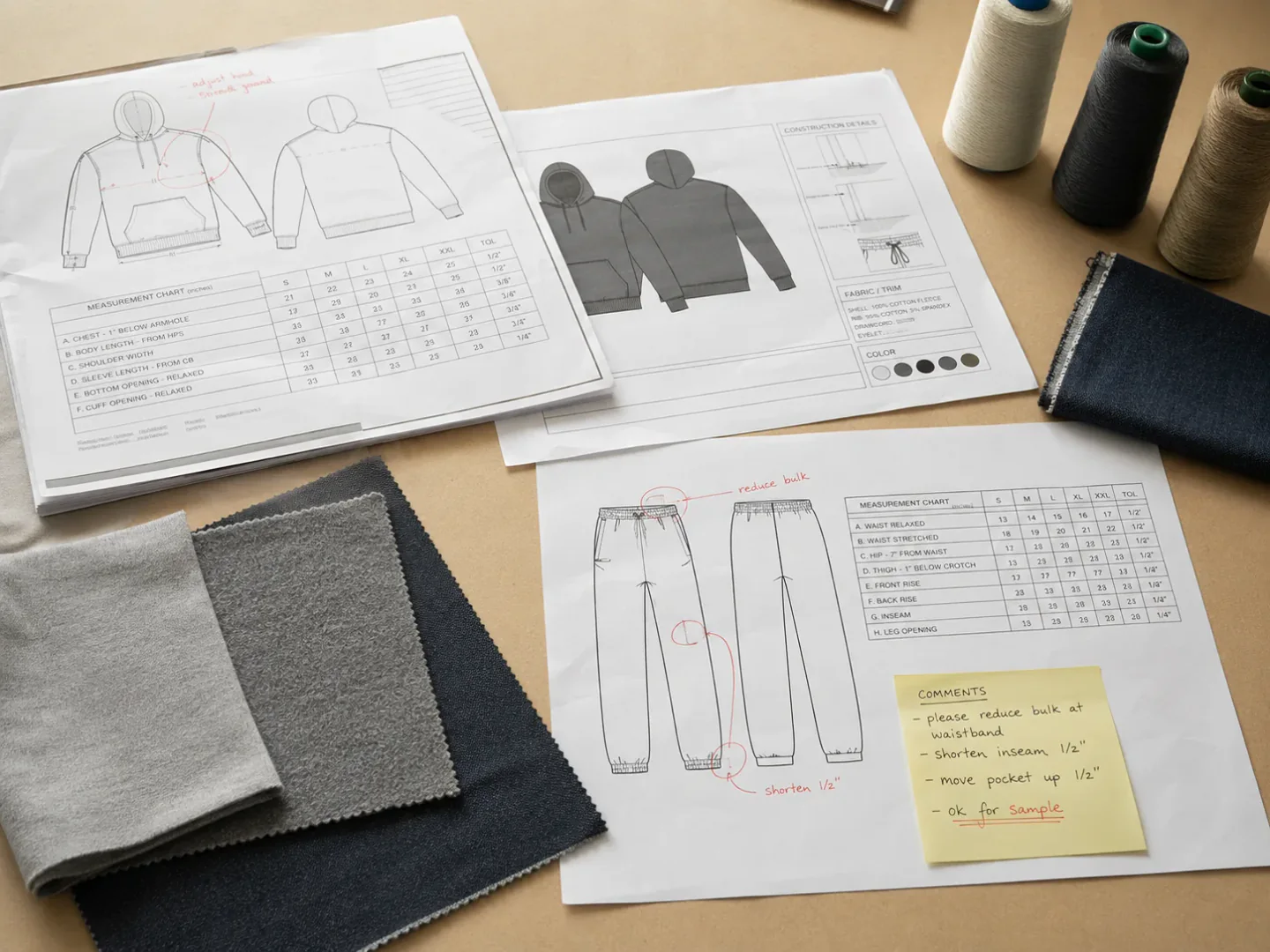
Fit comments should be measurable where possible. "Make it slightly better" gives a pattern team little technical direction. A comment such as "reduce body width according to revised measurement chart" is much easier to execute when the corresponding measurement is updated.
This is where a controlled garment Tech Pack becomes important. The physical sample and written specification should point to the same approved version.
Size set sample
Approving one base-size fit does not automatically prove that all other sizes will work.
A size set is used to evaluate the grading of the approved pattern across selected sizes.
The buyer should examine whether:
- graded measurements follow the approved rules;
- proportions remain appropriate;
- openings remain functional;
- design details stay visually balanced;
- garment length and width progression make sense;
- the intended silhouette is maintained.
Current ASTM apparel sizing terminology and measurement standards also reinforce the importance of clearly defined body and garment measurement terminology when working across size ranges.
The buyer does not have to use the same size-set procedure for every product. The required sizes and approval method should be specified by the brand rather than assumed by the factory.
PP, TOP and shipment samples: controlling the move into bulk
The later sample stages answer a different question: is the approved product actually being reproduced correctly in production?
Pre-production sample
PP means pre-production.
By this point, development decisions should normally be substantially closed. The PP sample should represent the intended production specification using the approved materials, trims, construction, branding and finishing applicable to the order.
Before PP approval, the buyer should check items such as:
- correct fabric or yarn;
- colour approval;
- measurements;
- construction;
- thread;
- trims;
- zipper or button specification;
- print or embroidery;
- main label;
- care label;
- hangtag;
- finishing;
- packing requirements where applicable.
Bangladesh skills-development material places PP sample approval before pilot and bulk production in the order execution flow, and more recent SICIP supply-chain material identifies buyer approval of a pre-production sample before full-scale production as a control against wrong production.
This does not mean every buyer must operate an identical PP procedure. It means the production-release gate needs to be explicit.
Our separate pre-production approval checklist covers the broader operational release process. This article stays focused on sample roles.
Top of production sample
A TOP sample is taken from actual production, generally from the early production output according to the buyer's procedure.
Its purpose is to compare real production against the approved standard.
The buyer or quality team may examine:
- measurements;
- workmanship;
- material;
- colour;
- decoration;
- trims;
- labels;
- finishing.
A TOP sample is valuable because sample-room execution and actual line production are not identical environments.
The International Labour Organization's apparel good-practice guidance recommends displaying a buyer's sample and production line sample as physical references so workers and supervisors can see the required design, dimensions and quality.
This illustrates an important principle: an approved physical reference becomes more useful when it is accessible to the people actually producing and checking the garment.
Shipment sample
A shipment sample is normally taken from completed finished goods representing what is being shipped.
It may be retained by the buyer, supplier or both depending on the agreed process.
A shipment sample can provide a useful reference for:
- final appearance;
- labelling;
- folding;
- retail presentation;
- packed condition;
- later comparison if a question arises after delivery.
However, a shipment sample is not the same as a statistical final inspection.
ISO 2859-1:2026 defines acceptance sampling schemes for lot-by-lot inspection using an Acceptance Quality Limit. That process assesses a defined sample from a production lot according to an inspection plan. One retained shipment garment cannot substitute for such an inspection method.
For that subject, see our separate AQL garment inspection guide.
Counter samples and salesman samples have different commercial roles
Not every sample exists mainly to approve fit or production.
A counter sample is commonly used as a physical reference or duplicate within the agreed buyer-supplier workflow. If a buyer has an approved sample in its office, a corresponding reference may be retained by the production side so both teams can compare against the same product direction.
The important control is identification.
The reference should show information such as:
- buyer;
- style;
- season or order reference;
- sample type;
- sample version;
- approval status;
- approval date where applicable.
A salesman sample, often abbreviated SMS, serves a different purpose.
It can be prepared for sales meetings, showrooms, wholesale presentation, photography or order collection according to the brand's commercial process.
That means an SMS may look commercially finished but should not automatically be treated as the final bulk-production approval.
A product may still require later technical corrections, final material approvals or PP confirmation.
For founders in particular, this distinction matters. A visually convincing sales sample can feel "finished", but production control requires more than appearance.
Buyer sample approval checklist
For each sample submission, use a repeatable review structure rather than approving from memory.
Identification
- Confirm style number and product description.
- Confirm sample type.
- Confirm sample version.
- Confirm colour and size.
- Confirm the Tech Pack version being used.
Measurements and fit
- Measure required points against the specification.
- Record actual measurements.
- Assess fit and balance where relevant.
- Identify any pattern corrections clearly.
- Update the measurement chart if the specification changes.
Materials
- Confirm fabric or yarn status.
- Confirm approved colour where applicable.
- Confirm trims and accessories.
- Identify temporary substitutions rather than silently accepting them.
Construction and appearance
- Check seams and construction details.
- Check print, embroidery or other decoration.
- Check placement of labels and branding.
- Review finishing and overall appearance.
Approval status
Use an unambiguous decision such as:
- approved;
- approved with clearly recorded corrections;
- rejected and resubmit.
Do not mix contradictory instructions across email threads, spreadsheets and messaging platforms without updating the controlling specification.
The Bangladesh apparel merchandising training framework specifically emphasises maintaining sample comment sheets, approved trim references and other order records.
For private label programs, these controls sit within the wider private label and OEM development process.
A practical sample flow for a Bangladesh sourcing program
Consider a new private label sweatshirt.
The first proto may confirm the overall silhouette, hood construction and pocket shape.
The fit sample then focuses on body width, length, sleeve, shoulder position and overall balance.
After base-size approval, a size set may be requested to evaluate grading in selected sizes.
Once production fabric, rib, drawcord, labels, embroidery and packing details are approved, the PP sample provides the production-intent reference.
After production begins, the buyer's quality process may require a TOP sample from actual production.
A shipment sample may finally be retained from completed goods.
This is only an example. A repeat style with an established pattern may not need the same development sequence as a completely new product. A technically complex outerwear style may require additional approvals that a basic T-shirt does not.
Sample planning also affects the Time and Action calendar, which is why repeated development rounds should be accounted for rather than treated as an unexpected interruption. Our Bangladesh garment lead-time guide discusses the wider planning factors.
Milky Fashions works as an independent sourcing partner in Dhaka and does not own the partner factories used for production. Our role is to coordinate development and production requirements with suitable factories while keeping buyer approvals clear. You can read more about our garment sourcing services and sourcing model.
If you have a Tech Pack and want to discuss how a sampling sequence should be structured for a specific product, contact us on WhatsApp.
Frequently asked questions
What is a proto sample in garment manufacturing?
A proto sample is an early physical version of a design used to assess whether the garment concept, proportions and basic construction have been interpreted correctly. It should be treated as a development sample. Unless specifically agreed otherwise, buyers should not assume that a proto confirms final materials, final fitting or readiness for bulk production.
What is the difference between a fit sample and a PP sample?
A fit sample is primarily used to develop and approve fit, measurements, balance and pattern corrections. A PP sample comes later and is intended to confirm the final production specification before bulk production is released. Approving the fit therefore does not automatically constitute PP approval.
What is a size set sample?
A size set consists of samples in selected sizes used to check whether an approved base-size pattern has been graded correctly across the required size range. Buyers should review measurements, proportions, design balance and fitting characteristics according to their own grading and fit standards.
Is a PP sample the final sample before production?
In many apparel programs, the approved PP sample is the main physical reference used to authorise movement into bulk production. However, buyer procedures differ. Some programs have additional approval gates, testing requirements or production samples. The required sequence should therefore be agreed for the specific order.
What is a TOP sample?
TOP means top of production. It is a sample taken from actual production output and used to check whether line production corresponds with the approved product standard. It is different from a PP sample because the TOP comes from the real production process rather than the pre-production development stage.
What is a shipment sample?
A shipment sample is a finished garment representing goods from the completed shipment. It may be used as a retained reference for final product appearance, labelling, packing or later comparison. It should not be confused with an AQL inspection sample or treated as proof that every garment in the shipment has been individually checked.
What is a counter sample in garments?
Counter sample terminology varies between companies, but it commonly refers to a duplicate or retained physical reference used within the buyer-supplier approval process. Because terminology differs, buyers should identify the exact version, approval status and purpose of any sample described as a counter sample.
What is a salesman sample?
A salesman sample, often called SMS, is generally produced for commercial presentation, such as showrooms, wholesale selling or range presentation. Its purpose is different from the PP sample. A salesman sample can represent the intended product visually without necessarily constituting final technical approval for bulk production.
Do all garment orders need every sample type?
No. The appropriate sample sequence depends on the product, buyer procedure, whether the style is new or repeated, fit complexity, material development and production risk. The important principle is not to create unnecessary sample rounds, but to ensure that every required technical and commercial decision has a clear approval point before the next stage begins.
Sources
- Bangladesh Skills for Employment Investment Programme, Apparel Merchandising Student Guide, garment order sampling and approved-sample records.
- Bangladesh Skills for Employment Investment Programme, Competency Standard for Apparel Merchandising, sample approval and order follow-up requirements.
- National Skills Development Authority, Bangladesh, Apparel Merchandising Level 4 materials, updated April 2024.
- Skills for Industry Competitiveness and Innovation Program, Supply Chain Management learning material, 2026, on pre-production approval controls.
- International Labour Organization, Good Practices: Apparel, guidance on production line samples and buyer references.
- ISO 2859-1:2026, sampling procedures for inspection by attributes and AQL-based lot inspection.
- ASTM D5219-25 and current ASTM apparel sizing standards, body-dimension terminology and measurement references.
Ready to discuss a sourcing brief?
Share your product family, sample status, and market destination. We will help you prepare the next conversation around the details you provide.
Discuss your sourcing brief on WhatsApp