Fabric defects found after cutting can become expensive garment defects. For apparel buyers sourcing from Bangladesh, fabric inspection before cutting is therefore a control point between material approval and garment production. The purpose is not simply to count visible faults. It is to decide, roll by roll and lot by lot, whether the delivered fabric matches the agreed quality requirements and whether problem areas need to be isolated before cutting.
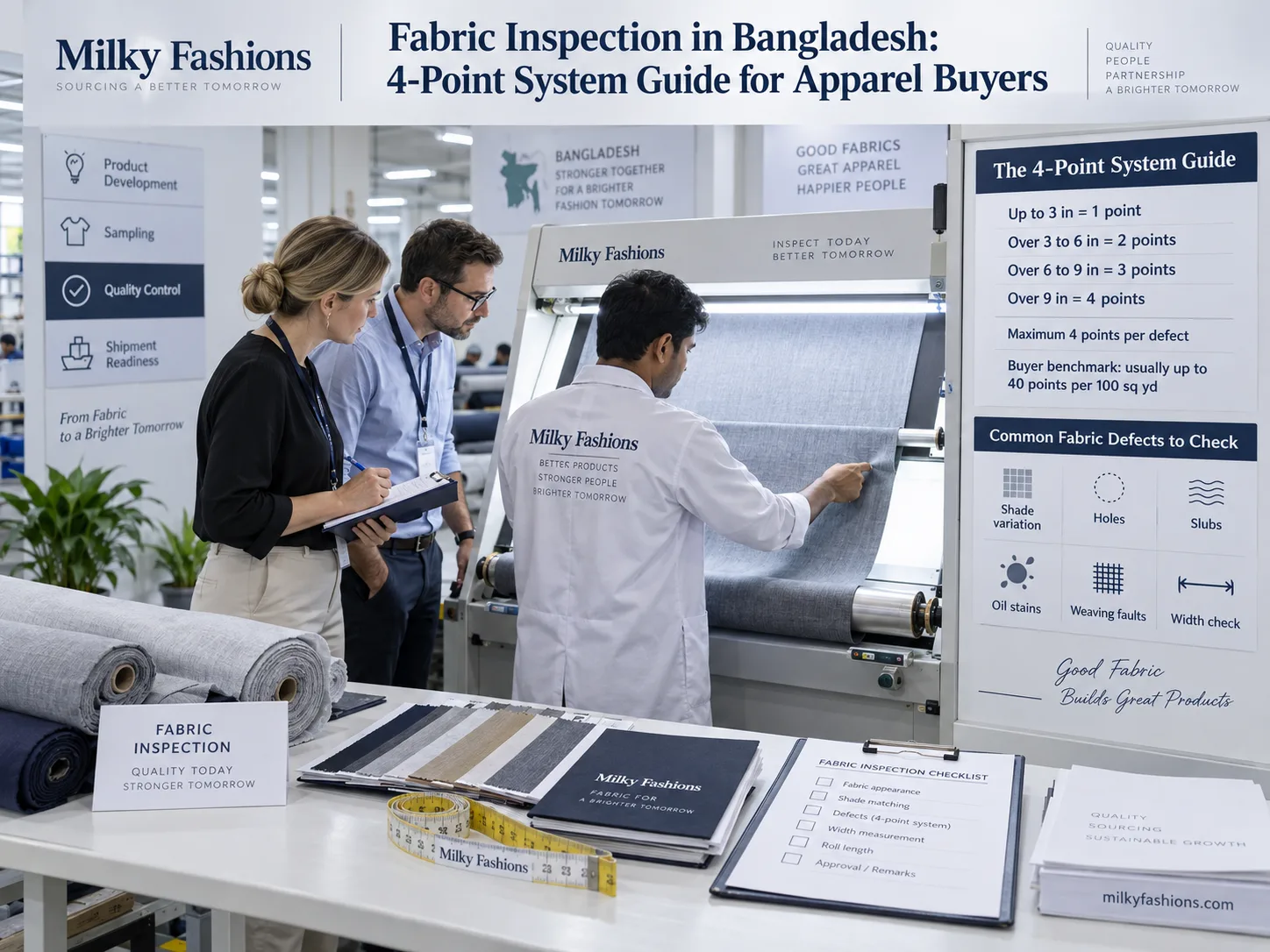
The 4-Point System is one of the most widely used methods for visually grading fabric defects. ASTM D5430-26, published in 2026, is the current ASTM standard for visually inspecting and grading fabrics. ASTM states that the method can be used for acceptance of individual rolls and shipments when purchaser and seller agree on its use. It also warns that different point-assignment options can produce different results, so both parties should use the same agreed method.
What is the 4-Point System in fabric inspection?
The short answer is: an inspector identifies visible fabric defects, assigns penalty points according to their size under the agreed scoring method, totals those points, and normalises the score to a standard fabric area.
A commonly used 4-Point schedule is:
| Defect length | Penalty points |
|---|---|
| Up to 3 inches | 1 |
| Over 3 inches up to 6 inches | 2 |
| Over 6 inches up to 9 inches | 3 |
| Over 9 inches | 4 |
Cotton Incorporated describes this same progression and states that no more than four total points should be assigned to one linear yard or metre under its summary of the system. It also assigns four points to a linear yard or metre affected by a long continuous running defect, insufficient usable width, or a full-width defect under that method. Intertek likewise describes a 1, 2, 3 and 4 point schedule based on defect size.
This scoring makes a 10-inch visible fault more serious than a 2-inch fault without allowing one defect to generate an unlimited number of penalty points.
However, buyers should not turn this table into an automatic fabric acceptance specification.
ASTM D5430 specifically frames acceptance around agreement between purchaser and seller. Cotton Incorporated makes the same practical point, noting that the grading method used in a commercial relationship should be clearly agreed by the parties.
How to calculate points per 100 square yards
Raw penalty points are not enough to compare rolls.
A 30-yard roll with 20 defect points is not equivalent to a 150-yard roll with 20 points. Fabric width also changes the total inspected area.
The score therefore needs to be normalised.
For fabric measured in yards and inches:
Points per 100 square yards = Total penalty points × 3,600 ÷ (fabric length inspected in yards × fabric width in inches)
The factor 3,600 comes from converting the inspected area into square yards and then expressing the result per 100 square yards.
Worked example
Assume a buyer's fabric roll has:
- inspected length: 120 yards
- fabric width: 60 inches
- total recorded penalty points: 28
First calculate the inspected area:
120 × 60 ÷ 36 = 200 square yards
Then calculate the normalised defect score:
28 ÷ 200 × 100 = 14 points per 100 square yards
The same result comes from the direct formula:
28 × 3,600 ÷ (120 × 60) = 14 points per 100 square yards
The calculation tells the buyer the defect density. It does not by itself tell the buyer whether the roll passes.
If the agreed specification allowed a score higher than 14, the numerical score might satisfy that criterion. If the buyer's specification required a lower result, it would not.
That acceptance threshold should come from the buyer specification, purchase agreement or approved quality manual, not from an assumed Bangladesh-wide number.
This distinction matters because claims online that every Bangladesh factory uses one fixed points limit are not supported by ASTM. The current ASTM standard explicitly bases fabric acceptance on conditions agreed by purchaser and seller.
What should buyers inspect besides the point score?
A 4-Point score measures visible defect density. A fabric can achieve an acceptable visual score and still create production problems.
Bangladesh's Skills for Employment Investment Program includes the 4-Point System within fabric quality-control competencies, but it separately identifies other checks such as GSM, shade, shrinkage and skewness for dyed fabric. It also identifies running shade, batch-to-batch shade variation, centre-to-side variation and side-to-side variation as relevant dyeing defects.
That distinction is important for buyers.
A practical pre-cut inspection can therefore include the following controls where relevant to the product:
| Check | Buyer question | Why it matters |
|---|---|---|
| Visible defects | Where are holes, stains, yarn faults or construction defects? | Defects can enter cut garment panels |
| Usable width | Does the roll provide the specified usable cutting width? | Width variation can affect consumption and marker efficiency |
| GSM or fabric weight | Is fabric weight within the agreed specification? | Weight can affect handfeel, drape, appearance and consumption |
| Shade | Are rolls and sections visually compatible? | Mixing shade groups can create panel-to-panel colour differences |
| Shrinkage | Has dimensional change been checked according to the buyer's requirement? | Unexpected shrinkage affects finished measurements |
| Bowing or skewing | Is fabric distortion within the agreed requirement? | Distortion can affect garment alignment and appearance |
| Fabric construction | Does the received material match the approved specification? | The wrong construction may perform differently |
| Roll identification | Can each result be traced to the correct roll and lot? | Traceability supports segregation and corrective action |
Intertek's description of fabric inspection similarly identifies fabric faults, colour, shading, usable width, hand, length and appearance as relevant fabric-inspection considerations.
The 4-Point score should therefore be one field in the inspection report, not the entire fabric-quality decision.
Woven and knitted fabric defects require different attention
The scoring logic can be applied across fabric types, but inspectors still need to recognise the defects associated with the construction being inspected.
Woven fabric
Typical woven risks can include defects such as:
- broken warp or weft;
- missing picks;
- double picks;
- reed marks;
- thick or thin places;
- knots;
- foreign yarn;
- oil marks;
- holes;
- width problems.
Bangladesh SEIP quality-control material specifically lists defects including double pick, reed mark, thick place, thin place, neps, oil marks, knots, foreign yarn, broken warp or weft, missing picks, holes and bariness within grey-fabric inspection competency.
A woven shirt fabric can also present additional risks from checks, yarn-dyed patterns, stripe alignment or printing. The buyer's specification should determine which visual conditions are acceptable.
Knitted fabric
Knitted fabric can present a different defect profile.
Potential problems can include:
- needle lines;
- dropped stitches;
- holes;
- barre or horizontal appearance variation;
- yarn contamination;
- oil spots;
- uneven dyeing;
- width instability;
- spirality or skew;
- shade variation.
Some structures also naturally contain openings. Pique, for example, has a visible micro-mesh structure as part of the construction, so inspection requires knowledge of what is intentional and what represents damage.
A hole caused by yarn breakage is very different from an intentional opening built into the textile structure.
Buyers should therefore make sure that inspectors have the approved fabric specification, physical reference where applicable and clear defect definitions.
Shade, GSM, shrinkage and skew need their own decisions
One of the biggest mistakes is assuming that a low visual defect score means the fabric is ready for cutting.
Consider shade variation.
A roll might contain few isolated visual defects but still differ noticeably from another roll. If panels from incompatible shade groups are cut into the same garment, the final piece can show colour variation even though each individual roll had a good 4-Point score.
Bangladesh quality-control competency documentation therefore treats shade control separately, including running shade, batch-to-batch variation, centre-to-side variation and side-to-side variation.
The same principle applies to GSM and shrinkage.
If a buyer specifies a particular fabric weight, that requirement should be tested separately from defect scoring. Shrinkage also requires its own method and approval criteria. The four-point calculation cannot tell you whether a fabric will remain dimensionally stable after the specified laundering process.
Skew or bow can likewise create problems even when the surface appears largely defect-free.
For this reason, a fabric release decision should combine the visual inspection result with whichever physical and performance tests are relevant to the product specification.
Chemical and regulatory testing is another separate subject. The 4-Point System does not prove compliance with REACH, restricted-substance requirements or certification claims. Those issues belong in the relevant compliance and testing process, not inside a visual fabric score.
A buyer checklist before fabric is released to cutting
A sourcing manager or product developer does not need to perform the inspection personally, but should know what evidence is expected.
Before cutting, consider confirming the following.
Specification
- Is the fabric article number correct?
- Is composition consistent with the approved specification?
- Is the construction correct?
- Is the approved colour clearly identified?
- Is the required usable width documented?
- Is required GSM or weight documented?
Roll inspection
- Which rolls were inspected?
- Is every inspected roll traceable by roll number?
- Which 4-Point scoring option was used?
- Are defects mapped or otherwise identified?
- Are major concentrated defects clearly flagged?
- Are holes, stains and continuous defects separately visible in the report?
- Is usable width recorded where required?
Shade control
- Are shade differences between rolls evaluated?
- Is head-to-tail variation checked where relevant?
- Are centre-to-side differences considered?
- Are incompatible shade groups segregated before cutting?
Physical testing
Depending on the product specification:
- Has GSM been checked?
- Has shrinkage been tested?
- Has skew or bow been evaluated?
- Have required colourfastness or performance tests been completed?
- Are results linked to the correct fabric lot?
Release decision
The final status should be unambiguous:
- released;
- conditionally released with documented restrictions;
- held for review;
- rejected.
Do not let an informal message such as "fabric okay" replace a traceable release record.
For the wider production-release process, see our pre-production approval checklist. Buyers should also keep material requirements aligned with the approved garment Tech Pack.
Fabric inspection is not garment AQL inspection
These two quality controls are often confused.
The 4-Point System deals with fabric defects and fabric grading. Finished-garment AQL inspection uses a sampling plan to assess a lot of completed garments against defined defect classifications and acceptance rules.
A fabric roll can therefore pass its agreed visual inspection and the finished garment lot can still fail a later inspection because of sewing, measurements, finishing, labels or packing.
The opposite can also occur: defective fabric may create garment-quality problems before the sewing line has any opportunity to correct them.
Our AQL garment quality-control guide covers finished-garment acceptance sampling separately.
Fabric inspection also differs from garment sample development. A development sample proves aspects of the garment specification, while bulk-fabric inspection checks the material actually received for production.
This separation of controls is useful because it makes responsibility easier to trace:
Material approval → bulk fabric inspection → cutting release → garment production controls → finished-garment inspection
The exact gates vary by buyer, but each decision should have its own evidence.
How Milky Fashions approaches fabric-quality coordination
Milky Fashions is an independent sourcing partner and garment buying house in Dhaka. We do not own the factories used for production.
Our role is to help coordinate buyer requirements with suitable partner factories and follow the development and production process according to the agreed brief.
For fabric-quality planning, the buyer should establish the required fabric specification, testing requirements, inspection method and acceptance criteria before bulk cutting. The factory and relevant fabric supplier can then be evaluated against that defined standard rather than against assumptions introduced after production begins.
This fits the wider buyer-control approach described in our sourcing model and garment sourcing services.
Fabric approval can also affect the production calendar. If a material requires replacement, segregation, additional testing or corrective action, cutting may need to wait. Buyers planning critical delivery windows should therefore build material approval into the Bangladesh garment lead-time rather than treating it as an invisible step.
If you are developing a private-label or OEM garment in Bangladesh and want to discuss how fabric approval and production coordination should be structured, send your Tech Pack and material requirements through WhatsApp.
Frequently asked questions
What is the 4-Point System in fabric inspection?
It is a visual fabric-grading method in which defects receive penalty points according to their size under an agreed scoring schedule. The points are then normalised to a defined area, commonly 100 square yards. ASTM D5430-26 is the current ASTM standard covering visual inspection and grading of fabrics.
How are defects scored under the 4-Point System?
Under a commonly used schedule, a defect up to 3 inches receives one point, over 3 to 6 inches receives two, over 6 to 9 inches receives three, and over 9 inches receives four. Cotton Incorporated and Intertek both describe this 1-to-4 progression. The exact scoring option should still be agreed between buyer and supplier.
What is the formula for 4-Point fabric inspection?
When length is measured in yards and width in inches, the calculation is: total penalty points multiplied by 3,600, divided by inspected length in yards multiplied by fabric width in inches. This expresses the result as points per 100 square yards.
What is an acceptable 4-Point System score?
There is no single universal pass score that should automatically be applied to every fabric order. ASTM states that the method may be used for acceptance when buyer and seller agree on its application. Buyers should therefore define the required acceptance criteria before inspection rather than copying an unexplained threshold from another brand or supplier.
Does the 4-Point System apply to knitted fabric?
It can be used to visually grade different fabric constructions, but the inspector must understand the construction being assessed. Knitted fabrics can present defects such as needle lines, dropped stitches, holes or appearance variation that differ from typical woven defects. The buyer's own material specification remains important.
Are GSM and shrinkage included in the 4-Point score?
No. GSM, shrinkage and similar physical properties require separate checks. Bangladesh quality-control training materials treat GSM, shrinkage, skewness and other physical tests separately from 4-Point fabric inspection.
Is shade variation part of fabric inspection?
Shade should be controlled during bulk-fabric approval, but it should not be reduced to the numerical 4-Point defect score alone. Running shade, batch-to-batch shade differences and centre-to-side or side-to-side variation may need separate evaluation and segregation before cutting.
Is the 4-Point System the same as AQL?
No. The 4-Point System grades fabric defects. AQL-based inspection is a statistical acceptance-sampling approach often used for finished goods or other lot-inspection applications. A fabric inspection result should not be presented as if it were a finished-garment AQL result.
Should fabric be inspected before cutting?
Bulk fabric should be evaluated against the buyer's agreed material and quality requirements before it is released into cutting. The exact inspection scope depends on the buyer's procedure, fabric risk and commercial agreement. Early identification allows affected rolls or sections to be held, segregated or reviewed before they become cut garment panels.
Sources
- ASTM International, ASTM D5430-26, Standard Test Methods for Visually Inspecting and Grading Fabrics, current 2026 edition.
- ANSI and BSI listings for ASTM D5430-26, confirming the current 2026 standard and scope.
- Cotton Incorporated, Fabric Defects Classification, including Four-Point defect scoring and linear-yard rules.
- Intertek, Fabric Inspection, covering 4-Point scoring and additional fabric inspection criteria such as colour, shading, usable width and appearance.
- Bangladesh Skills for Employment Investment Program, quality-control competency standards covering 4-Point fabric inspection, shade variation, GSM, shrinkage and skewness.
Ready to discuss a sourcing brief?
Share your product family, sample status, and market destination. We will help you prepare the next conversation around the details you provide.
Discuss your sourcing brief on WhatsApp