
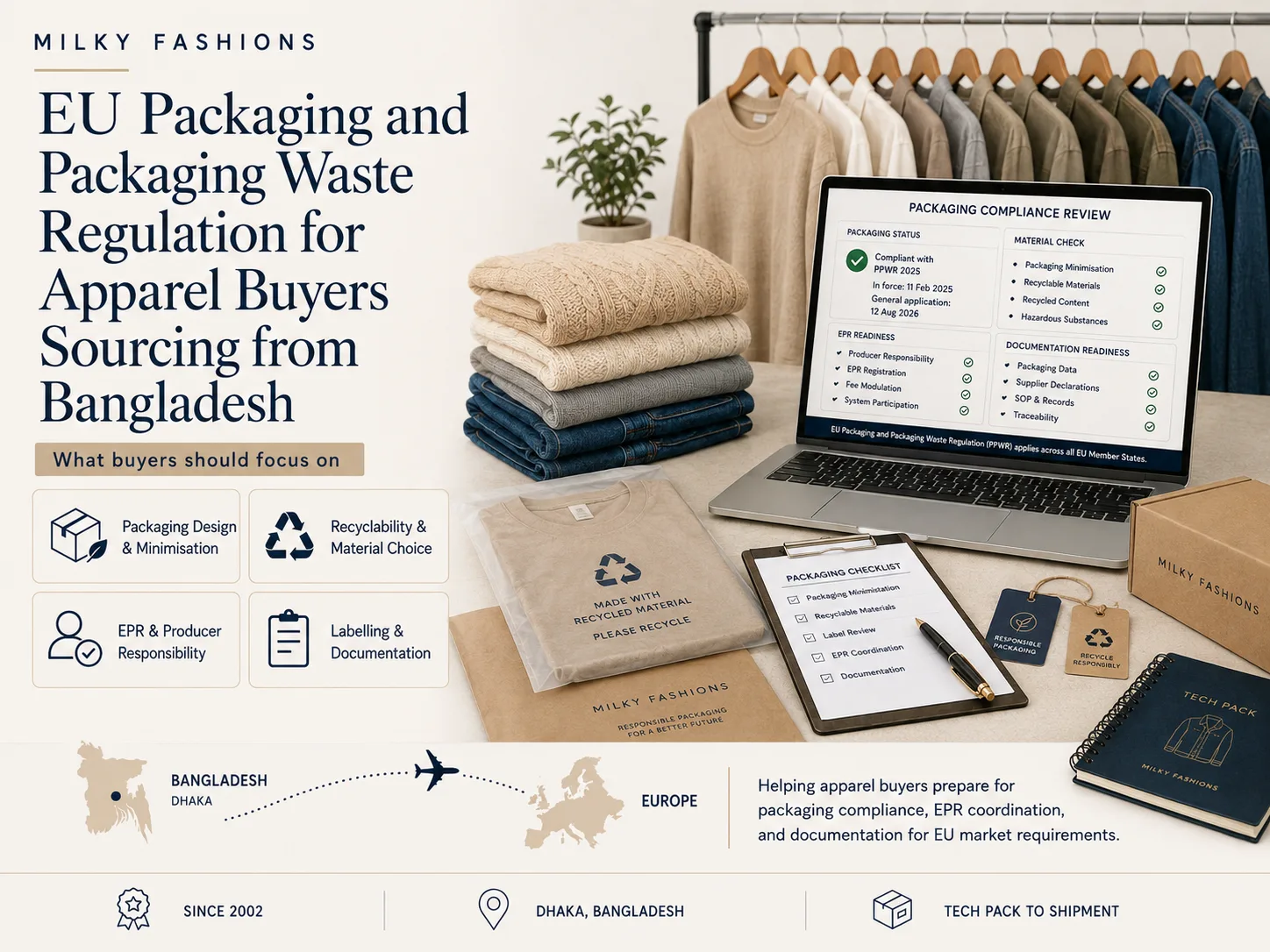
What PPWR changes for apparel buyers sourcing from Bangladesh
The EU Packaging and Packaging Waste Regulation, Regulation (EU) 2025/40, now matters directly to European fashion brands importing garments from Bangladesh. The PPWR entered into force on 11 February 2025 and generally applies from 12 August 2026. It covers packaging of all materials and introduces requirements for packaging sustainability, recyclability, recycled content, minimisation, labelling, conformity documentation and extended producer responsibility.
For an apparel sourcing manager, this means packaging can no longer sit only at the end of the purchase order as a line saying "individual polybag, export carton." Garment polybags, plastic mailers, paper mailers, retail boxes, grouped cartons and e-commerce delivery packaging can all require closer technical control. A German buyer in Berlin, a Polish importer in Warsaw, a Spanish product team in Barcelona or a French sourcing manager in Paris should start defining packaging alongside the garment specification, not after the pre-production sample has been approved.
Milky Fashions is an independent apparel sourcing partner and garment buying house in Dhaka. We do not own factories. We can coordinate buyer packaging specifications and relevant supplier information through partner factories, while the European buyer determines its own legal role and PPWR obligations.
Buyers who need the wider regulatory context should also review our EU apparel compliance guide and EU textile regulations for Bangladesh sourcing.
Which apparel packaging formats can fall within PPWR
The PPWR defines packaging broadly as an item used for containment, protection, handling, delivery or presentation of products. It applies regardless of packaging material. For fashion supply chains, that makes the scope wider than a single retail bag or shipping carton.
Typical PPWR apparel packaging to assess can include:
| Packaging point | Apparel example | Buyer question |
|---|---|---|
| Garment-level packaging | LDPE or other garment polybag | What polymer, weight, dimensions and recycled content are specified? |
| Retail packaging | Garment box, paper sleeve or presentation packaging | Is every component necessary and designed for recyclability? |
| Grouped packaging | Inner carton or bag grouping multiple units | Is excess packaging being introduced? |
| Transport packaging | Export carton, pallet wrap, straps | Who specifies and documents the packaging? |
| E-commerce packaging | Plastic mailer, paper mailer or shipping box | Is it right-sized and designed for future empty-space limits? |
| Protective components | Tissue, inserts or filling materials | Are they essential for product protection? |
Industry competitor pages currently ranking around EU packaging regulation for fashion brands, PPWR garment polybags, PPWR e-commerce packaging, apparel packaging compliance and packaging compliance for apparel importers focus heavily on polybags, mailers, cartons, supplier data and declarations of conformity. That search pattern is useful because it reflects the practical questions apparel buyers are asking, rather than treating PPWR as an abstract waste-policy topic.
One caution concerns hangtags. An attached item is not automatically packaging merely because it accompanies a garment. Its actual function under the PPWR definition needs to be assessed. Buyer teams should therefore avoid applying generic packaging classifications without checking the relevant format and use.
For private label programs, packaging should also be connected to the garment brief. Our private label and OEM apparel page explains the broader product-development route, while the pre-production approval checklist covers the approval discipline around bulk release.
The PPWR timeline apparel teams should plan around
Not every PPWR requirement started on 12 August 2026. Several important packaging design obligations phase in later.
Now, from 12 August 2026
The Regulation generally applies across the EU. Manufacturers of packaging must ensure conformity with applicable requirements, carry out or arrange conformity assessment, prepare technical documentation and issue an EU Declaration of Conformity when compliance has been demonstrated. Packaging suppliers must provide manufacturers with the information and documentation necessary to support that conformity work. Importers have their own duties to check conformity before placing packaging on the market.
This is particularly relevant to Bangladesh sourcing because the European brand should not assume that its garment factory's usual packing list contains all PPWR information automatically.
From 2028
Article 24 requires economic operators filling sales packaging to reduce empty space to the minimum necessary by 12 February 2028.
Harmonised material-composition labelling is scheduled from 12 August 2028 or 24 months after the relevant implementing acts enter into force, whichever is later. The exact implementation sequence therefore needs to be monitored rather than hard-coded into packaging artwork years in advance.
Toward 2030
By 1 January 2030, packaging manufacturers or importers must ensure packaging weight and volume are reduced to the minimum necessary for functionality. All packaging is also intended to meet the PPWR recyclability requirements from 2030.
For grouped, transport and PPWR e-commerce packaging, Article 24 sets a maximum 50 percent empty-space ratio by 1 January 2030 or three years after the relevant implementing acts enter into force, whichever is later. Filling material such as paper cuttings, air cushions, bubble wrap and foam counts as empty space for this calculation.
For plastic packaging, Article 7 sets minimum post-consumer recycled-content percentages for 2030. Plastic packaging outside the specified contact-sensitive and beverage categories has a 35 percent target. Many ordinary non-contact-sensitive garment polybags and plastic mailers may potentially sit in this category, subject to the Regulation's detailed classification rules and exemptions. Buyers should verify the treatment of their actual packaging rather than write "35% PCR required" into every specification without assessment.
For fashion brands running high-volume online programs, these dates make packaging design a sourcing issue now, even when the 2030 requirement has not yet taken effect.
Our European online fashion retailer sourcing page covers the wider operating model for e-commerce apparel programs.
What European buyers should request from Bangladesh suppliers
The strongest competitor gap around PPWR is not another explanation of the acronym. It is supplier packaging data.
European brands will need enough information to understand what their packaging actually is and support the economic operator responsible for conformity. Article 16 specifically requires packaging suppliers to provide manufacturers with information and documentation necessary to demonstrate compliance.
A practical apparel packaging specification should therefore capture:
- Packaging reference: Give each polybag, mailer, carton or box a controlled reference number.
- Material composition: Record the polymer, paper or board type and significant components.
- Weight and dimensions: Keep actual packaging weight, thickness where relevant, and dimensions.
- Recycled-content information: Where recycled plastic is specified, identify the percentage and supporting evidence required by the buyer.
- Construction: Record closures, windows, adhesives, coatings, laminations, printing and other features that may influence recyclability.
- Packaging function: Identify whether it is sales, grouped, transport or e-commerce packaging where this classification is relevant.
- Supplier identity: Maintain the packaging supplier or converter information connected to the approved reference.
- Technical documentation: Ask the relevant packaging supplier what documentation supports conformity with the applicable PPWR requirements.
- Version control: Packaging artwork and construction revisions should have the same approval discipline as garment trims.
- Market destination: Record whether the order is destined for Germany, Poland, Spain, France or multiple EU markets.
This information should sit alongside the garment specification rather than being reconstructed after shipment.
For example, a French product team in Paris may approve a recycled-content polybag for a hoodie program sourced from Bangladesh. If the German division in Hamburg later uses a different e-commerce mailer around the same garment, those are different packaging configurations and may have different responsible economic operators and compliance evidence.
This is why garment sample development in Bangladesh and packaging approval should communicate with each other. The PP sample can confirm garment presentation and folding, but the controlled packaging specification should establish the actual packaging material, dimensions and approved construction.
Germany, Poland, Spain and France need one EU core file, not one generic market assumption
PPWR creates harmonised EU packaging rules, but sourcing teams should still identify their role and route to market for every Member State.
The Regulation distinguishes between the "manufacturer" responsible for packaging conformity and the "producer" responsible for extended producer responsibility in a Member State. These are not always the same legal entity. The Commission's 2026 guidance explains that producer responsibility depends on which economic operator first makes the packaging or packaged product available in the relevant Member State.
That distinction matters for European fashion groups.
A brand operating from Berlin or Munich should not assume that an existing German LUCID registration answers every PPWR product-compliance question. Germany's packaging register itself now tells companies to reassess their role under PPWR.
Likewise, a Warsaw or Krakow apparel importer, a Madrid or Barcelona fashion company, and a Paris or Lyon brand should avoid treating "EU packaging compliance" as one registration number copied into every market file.
The better model is:
One central packaging specification: material, construction, dimensions, weight, recycled content and supplier evidence.
One product-to-packaging link: which packaging reference applies to which garment SKU or collection.
Market-specific responsibility mapping: identify the economic operator and any national EPR requirements for the country where packaging is first made available.
For broader sourcing requirements in each market, see our dedicated pages for German fashion brands, Polish fashion brands, Spanish fashion brands and French fashion brands.
Packaging EPR should also not be confused with textile EPR. Our separate guide to EU textile EPR for apparel buyers sourcing from Bangladesh explains the end-of-life responsibility being introduced for textiles themselves.
A PPWR readiness checklist for Bangladesh apparel sourcing
For apparel teams updating packaging now, the useful goal is not to predict every 2030 technical standard. It is to avoid locking future problems into current packaging specifications.
Before approving packaging for a Bangladesh order, ask:
- Have we identified every packaging component used from garment packing through European delivery?
- Is the polybag or mailer material clearly specified?
- Do we have the packaging weight and dimensions?
- Is recycled content documented where we specify or claim it?
- Are mixed materials, coatings, windows, closures or laminations necessary?
- Could the same protective function be achieved with less weight or volume?
- Is the e-commerce box appropriately sized for the product?
- Have we considered the future 50 percent empty-space rule for grouped, transport and e-commerce packaging?
- Can the packaging supplier provide information needed for PPWR technical documentation?
- Does the packaging have a controlled reference and approval history?
- Do sourcing, sustainability, logistics and e-commerce teams use the same packaging data?
- Have we identified who is responsible for conformity and who is the EPR producer in each target market?
Milky Fashions can coordinate the Bangladesh side by carrying an approved packaging requirement into partner-factory communication and collecting relevant factory-side or packaging-supplier information requested by the buyer. Our wider garment sourcing from Bangladesh service explains how these requirements fit into product development, sampling, production coordination and shipment readiness.
There is an important limit. Milky Fashions cannot guarantee that a packaging format is PPWR compliant, determine the buyer's final legal role, issue legal advice, or promise that a particular recycled-content percentage or packaging design will remain sufficient as secondary legislation develops. European buyers should confirm legal interpretations and conformity responsibilities with qualified advisers and the relevant authorities.
If you are updating polybags, cartons or e-commerce packaging for a private label program in Bangladesh, send the current packaging specification together with your garment brief through WhatsApp. We can help identify which supplier information should be clarified before the packaging is released for bulk.
Frequently asked questions
Does PPWR apply to garment polybags?
Potentially, yes. PPWR covers packaging used for containment, protection, handling, delivery or presentation, regardless of material. A garment polybag used to protect and deliver clothing normally needs to be assessed as packaging under that definition. Its exact obligations depend on its role, material and the applicable PPWR provision.
Does PPWR apply to apparel imported from Bangladesh?
Yes. PPWR applies to packaging placed on the EU market regardless of where the packaged garment was manufactured. The important compliance questions concern the packaging, the economic operators involved and how the packaged product is placed on the EU market, not whether the clothing was sewn inside or outside Europe.
Will garment polybags need 35 percent recycled content?
Article 7 sets a 35 percent minimum for plastic packaging that is outside the specified contact-sensitive and beverage packaging categories from 2030. Many ordinary apparel polybags may potentially fall into that category, but buyers should verify the exact classification and any applicable exemptions before treating 35 percent as a universal rule for every packaging format.
What is the PPWR 50 percent empty-space rule?
For grouped, transport and e-commerce packaging, the PPWR sets a maximum empty-space ratio of 50 percent from 1 January 2030 or three years after the relevant implementing methodology enters into force, whichever is later. Filling materials such as air cushions, bubble wrap and paper filling count as empty space.
Does an apparel brand need an EU Declaration of Conformity for packaging?
The PPWR requires the packaging manufacturer, as defined by the Regulation, to carry out the conformity process and draw up an EU Declaration of Conformity once compliance is demonstrated. Importantly, the PPWR definition of manufacturer can include the entity that has packaging or a packaged product designed or manufactured under its own name or trademark, subject to specific exceptions. Brands should therefore determine their actual legal role instead of assuming the packaging converter always carries this responsibility.
What packaging data should a European buyer request from a Bangladesh factory?
Start with packaging material, dimensions, weight, construction, recycled-content information where relevant, supplier identity, approved artwork or specification and the supporting information available from the packaging supplier. The exact documentation required depends on the packaging and the legal role of the parties involved.
Is PPWR the same as packaging EPR?
No. PPWR contains extended producer responsibility provisions, but product-design and conformity requirements such as recyclability, recycled content, minimisation and technical documentation are different obligations. A company should distinguish the manufacturer responsible for packaging conformity from the producer responsible for EPR in a Member State.
Sources
- Regulation (EU) 2025/40 on packaging and packaging waste, EUR-Lex.
- European Commission, new EU packaging rules applying from 12 August 2026.
- European Commission Guidance Document for Regulation (EU) 2025/40, June 2026.
- European Commission PPWR FAQ, August 2026.
- EUR-Lex, Articles 15 to 18 on manufacturer, supplier and importer obligations.
- German Central Agency Packaging Register, current LUCID guidance following PPWR application.
Ready to discuss a sourcing brief?
Share your product family, sample status, and market destination. We will help you prepare the next conversation around the details you provide.
Discuss your sourcing brief on WhatsApp