
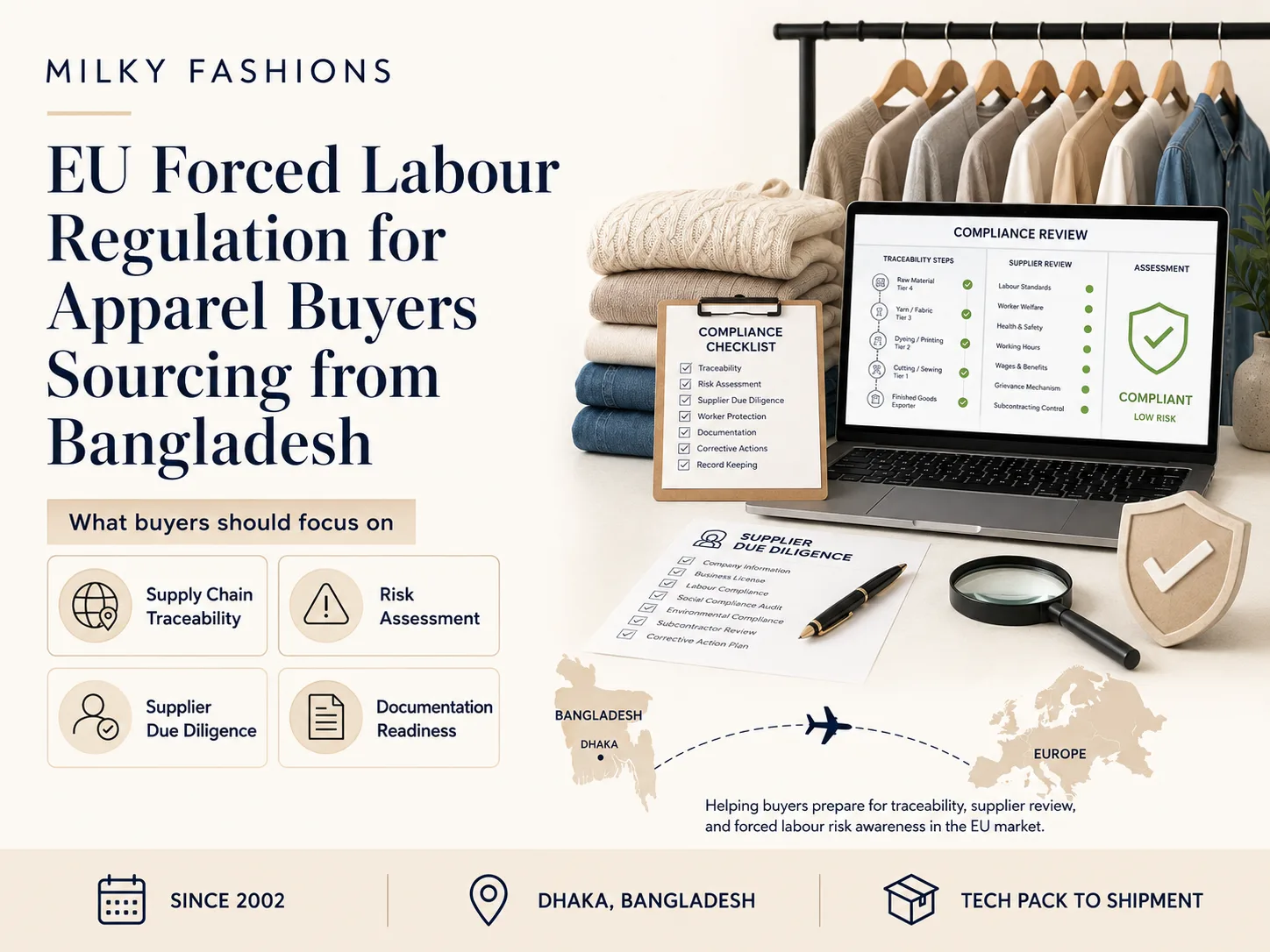
What the EU Forced Labour Regulation means for apparel sourcing from Bangladesh
The EU Forced Labour Regulation, Regulation (EU) 2024/3015, changes the compliance risk for European apparel companies sourcing garments from Bangladesh. From 14 December 2027, products made wholly or partly using forced labour cannot be placed or made available on the EU market, or exported from it. The rule covers all products, all sectors and companies of all sizes. It is a product prohibition, not simply another sustainability reporting requirement.
For sourcing managers, compliance teams and product developers in France, the practical issue is therefore product-level evidence and supply chain traceability. A French buyer sourcing a finished garment from Bangladesh may need to understand not only the final sewing factory, but also relevant upstream production stages, suppliers, components and materials where a forced labour risk could arise. Importantly, the Regulation does not single out Bangladesh. It applies regardless of product origin, and enforcement is designed around factual, verifiable and risk-based information.
The EUFLR is a product ban, not an audit requirement
One of the most important distinctions for apparel buyers is what the EU Forced Labour Regulation, often shortened to EUFLR, does and does not require.
The Regulation prohibits an economic operator from placing or making available a product made with forced labour on the EU market, or exporting such a product from the EU. Forced labour can occur at any stage of extraction, harvesting, production, manufacturing, processing or other work connected with the product. The scope therefore extends beyond final garment assembly.
At the same time, the European Commission explicitly states that the EUFLR does not create an audit obligation or a new sustainability due diligence obligation of its own. Companies decide how they will ensure that their products are not made with forced labour. Voluntary forced labour due diligence, however, can help a company prevent risks and provide useful evidence if authorities assess a product.
That difference matters for apparel sourcing.
A social audit, certification, supplier declaration or code of conduct may form part of a wider evidence file. None should be treated as an automatic safe harbour from the Regulation. The Commission's 2026 guidance instead points companies toward an ongoing process of identifying risks, preventing or mitigating them, monitoring effectiveness, communicating internally and addressing actual impacts where appropriate.
The same principle applies when sourcing through Milky Fashions. Milky Fashions is an independent sourcing partner and garment buying house in Dhaka. It does not own factories and does not itself hold factory certifications such as BSCI, GOTS or OEKO-TEX. Where a buyer requires specific factory audits, certifications or documentation, the relevant partner factory and the applicable scope need to be checked for that program.
Why apparel supply chain traceability matters
The search terms appearing repeatedly across current EUFLR guidance and specialist competitor coverage include supply chain traceability, supplier mapping, forced labour due diligence, risk assessment, supplier engagement, corrective action plans, product-level evidence and supply chain transparency. Those concepts are especially relevant to apparel because garments are typically multi-stage products.
A simple garment may involve raw material production, spinning, knitting or weaving, dyeing and finishing, garment manufacturing, printing or embroidery, trims, packaging and possible subcontracted processes. The EU rule can apply if forced labour was used in whole or in part at any relevant production stage.
For a French apparel brand sourcing from Bangladesh, this does not mean every supplier must be treated as high risk. It means the buyer should be able to explain how it identifies and investigates meaningful risks instead of relying only on the name of the country, the final factory or one audit report.
The Commission's 2026 guidance recommends a risk-based approach. Companies can consider geographical, sector, product and company-specific risk factors, then investigate more deeply where the most significant risks are found. The guidance also recommends reviewing the assessment when circumstances materially change, including significant new sourcing or product development.
This has a direct implication for product developers. Supplier compliance cannot remain entirely separate from product development. A change of fabric mill, yarn origin, subcontracted process, trim supplier or production site can change the underlying supply chain that the compliance team thought it was assessing.
The OECD's 2026 work on garment and footwear due diligence also highlights the sector's fragmented and multi-tiered structure and notes that sourcing models, subcontracting, short lead times and buyer purchasing practices can influence labour risks.
A practical EUFLR readiness checklist for French apparel buyers
The following is a practical forced labour risk assessment and supplier mapping checklist, not a statutory list of documents prescribed by Regulation 2024/3015.
| Readiness area | What the buyer should establish | Useful evidence to organise |
|---|---|---|
| Final production site | Where the garments are actually manufactured | Factory identity, address, approved production records |
| Supplier mapping | Which relevant suppliers and processes sit behind the product | Fabric or yarn supplier, processing units, trims, subcontractors where relevant |
| Product linkage | How supplier information connects to the actual style or order | Style number, purchase order, material references, production records |
| Subcontracting control | Whether any production process may move outside approved facilities | Approved subcontractor list and change-control procedure |
| Forced labour risk assessment | Where credible product, geographic or labour risks may exist | Risk review, authoritative databases, ILO indicators, supplier information |
| Labour practices | Whether warning signs require further investigation | Working-time, wage, recruitment and worker-management information where appropriate |
| Supplier engagement | How identified concerns are communicated and addressed | Supplier correspondence, policies, training and agreed actions |
| Corrective action | What happens when a problem or credible risk is identified | Corrective action plan, responsibilities, deadlines and closure evidence |
| Worker voice | Whether meaningful grievance information can reach decision makers | Worker grievance mechanisms and evidence of follow-up |
| Record keeping | Whether sourcing, compliance and product teams can retrieve the same evidence | Controlled supplier files, current versions and responsible owner |
The objective is not to collect documents for the sake of having a large compliance folder. It is to create enough supply chain visibility to connect credible risk information with the product, supplier and production stage concerned.
The ILO's revised 2025 Indicators of Forced Labour are useful when assessing warning signs. They include abuse of vulnerability, deception, restriction of movement, intimidation and threats, retention of identity documents, withholding of wages, debt bondage, abusive working and living conditions, and excessive overtime, among other indicators. These indicators are clues for assessment, not automatic findings that forced labour has occurred.
For apparel sourcing teams, that distinction is important. Excessive working hours, for example, should not automatically be labelled forced labour without assessing coercion and the surrounding circumstances.
How an EU forced labour investigation could affect a French buyer
For products sourced from Bangladesh, an important procedural point is who leads an investigation.
The European Commission leads cases where the suspected forced labour occurs outside the EU. Member State competent authorities lead cases involving suspected forced labour within their own territory. Therefore, where the relevant suspected production activity is in Bangladesh, the European Commission would be the lead authority under the Regulation, while French and other EU authorities can participate in enforcement and cooperation.
Authorities use a risk-based approach. Relevant factors include the scale and severity of suspected forced labour, the volume of products concerned and the significance of the suspected component in the finished product. They can draw on the EU forced labour risk database, information from international organisations, civil society, workers, authorities and other factual and verifiable sources.
Before a formal investigation, an economic operator can be asked what actions it has taken to identify, prevent, mitigate, end or remediate forced labour risks relating to the product. Under Article 17, the operator normally has 30 working days to respond during this preliminary phase. The authority then has 30 working days after receiving that information to determine whether there is a substantiated concern warranting a formal investigation.
This is why assembling a forced labour compliance file only after receiving an authority request is a weak operating model. Sourcing, compliance and product teams should already know where current supplier information sits.
If an investigation establishes a violation, authorities can prohibit the product, order its withdrawal from the EU market and require disposal in accordance with the Regulation. Decisions can then be enforced across Member States.
There is another useful nuance. Financial penalties under Article 37 relate to non-compliance with an authority's decision. The Commission's 2026 penalty guidance makes clear that penalties are not simply imposed because a product was initially suspected of forced labour. Member States must have rules providing effective, proportionate and dissuasive penalties for failure to comply with a relevant decision.
What sourcing, compliance and product teams should change before 2027
The European Commission's own guidance makes EUFLR preparation a cross-functional responsibility. It specifically identifies compliance, risk management, product development, production, sales, buying and sourcing functions as teams that may need responsibility for different elements of forced labour due diligence.
For a French apparel business sourcing from Bangladesh, five operational changes are worth prioritising now.
First, connect supplier mapping to actual products. Avoid maintaining one generic approved-factory list that cannot show which facility, fabric source or processing unit relates to which styles.
Second, establish change control. Product development and merchandising should tell compliance when a fabric mill, manufacturing facility, subcontracted process or material source changes.
Third, strengthen supplier engagement rather than relying only on contractual clauses. Commission guidance states that contractual requirements can support due diligence but should be accompanied by appropriate follow-up and verification rather than being treated as sufficient by themselves.
Fourth, examine purchasing practices. Unrealistic development calendars, late approvals, compressed production windows and other buyer decisions can increase pressure in a garment supply chain. Both Commission and OECD guidance recognise that commercial and purchasing practices can affect labour risk.
Fifth, build an evidence-response process. Decide who can retrieve supplier records, risk assessments, audit information, corrective actions and product mapping if an authority asks for information.
A Bangladesh sourcing partner can help coordinate factory-side information, supplier communication, production-site confirmation and relevant documentation. The European brand, importer or other economic operator should still determine its own legal obligations and compliance framework.
This article also cannot promise that a particular audit, certification, supplier map or sourcing process will guarantee EUFLR compliance or prevent an investigation. The Regulation is enforced by EU authorities using the circumstances and evidence of each case. Buyers should obtain legal advice where interpretation of their specific obligations is required.
For sourcing teams that want to review how factory selection, production coordination and buyer documentation can be structured around a Bangladesh apparel program, Milky Fashions can discuss the sourcing brief through WhatsApp.
Frequently asked questions
When does the EU Forced Labour Regulation apply?
Regulation (EU) 2024/3015 entered into force in December 2024, but its central prohibition becomes applicable on 14 December 2027. From that date, products made with forced labour cannot be placed or made available on the EU market or exported from it.
Does the EU Forced Labour Regulation apply to garments made in Bangladesh?
Yes. The Regulation applies to products regardless of where they are produced. Bangladesh is not uniquely targeted by the law. The same prohibition applies to products from any non-EU or EU production location where forced labour is established in the relevant supply chain.
Does the EUFLR apply to small fashion brands and SMEs?
Yes. There is no general company-size exemption from the product prohibition. Enforcement is risk-based, and authorities are instructed to consider factors including an economic operator's size and resources when deciding where to focus.
Is forced labour due diligence mandatory under the EUFLR?
The EUFLR itself does not create a separate mandatory sustainability due diligence process. The Commission describes the forced labour due diligence guidance as voluntary. However, meaningful due diligence can reduce risk and provide important information during an authority's preliminary assessment or investigation. Other EU or national legislation can create separate due diligence obligations for companies within its scope.
Is a BSCI, Sedex, WRAP or other factory audit enough for EUFLR compliance?
No single audit or certification should be treated as an EUFLR guarantee. The Regulation does not establish an approved audit certificate that automatically proves a product is free from forced labour. Relevant audits and corrective actions can form part of a broader evidence base, but buyers should also consider product-specific supplier information, credible risks, worker information and relevant upstream production stages.
How far back should an apparel buyer map its supply chain?
The Regulation can concern forced labour at any stage of extraction, harvesting, production or manufacturing, including processing related to the product. The appropriate depth of supplier mapping should therefore be risk-based rather than automatically stopping at the final sewing factory. In apparel, material and processing stages can be relevant where credible risks exist.
Who investigates a suspected forced labour issue connected to Bangladesh?
Where the suspected forced labour occurs outside the EU, the European Commission leads the investigation and adopts the relevant decision. National competent authorities handle cases occurring within their territories and participate in EU-wide enforcement and cooperation.
What should a French apparel buyer ask a Bangladesh supplier for now?
Start with information that improves product-level traceability: confirmed production sites, relevant material and processing suppliers, subcontracting information where applicable, labour-risk information, grievance and corrective-action evidence, and records linking those suppliers to the actual product or order. The exact information should be proportionate to the identified risk and should not be treated as a universal statutory document checklist.
Ready to discuss a sourcing brief?
Share your product family, sample status, and market destination. We will help you prepare the next conversation around the details you provide.
Discuss your sourcing brief on WhatsApp