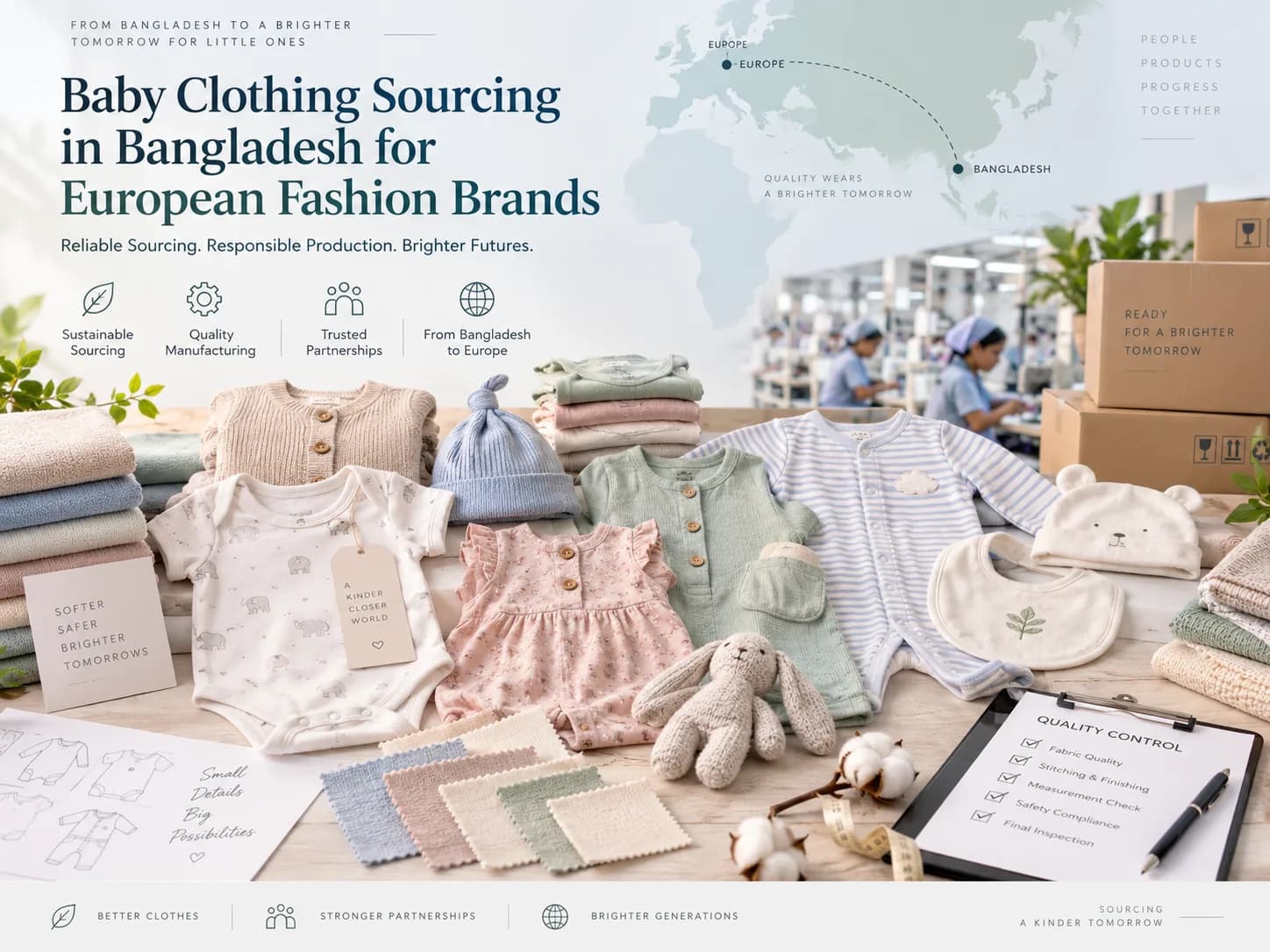
European babywear buyers need more than a factory that can sew a small garment. The product has to be developed around sensitive skin contact, secure trims, repeatable sizing, clear fibre information, buyer specific testing, and market requirements that differ between the EU and the UK. For brands in Germany, France, the Netherlands, and the UK, the practical challenge is therefore not simply finding production capacity in Bangladesh. It is selecting the right production partner for the exact babywear brief and controlling the development from sample through shipment.
Milky Fashions is an independent apparel sourcing partner and garment buying house in Dhaka, working since 2002. We do not own factories. We coordinate suitable partner factory selection, product development, sampling, costing, production follow up, quality control, compliance documentation, and export coordination according to the buyer's requirements. Bangladesh has an established export base for knitted apparel, and Bangladesh Export Promotion Bureau records include exporters registered for knitted baby garments.
Why babywear needs a category specific sourcing process
Baby clothing looks simple, but the risk profile is different from a standard adult T shirt or sweatshirt. A bodysuit can involve neck stretch, binding recovery, crotch snap positioning, diaper allowance, print placement, and wash shrinkage within a very small garment. A sleepsuit may add zipper or snap performance, foot shape, cuff construction, and stricter attention to trim security. Multipacks add another layer because colour, size ratios, folding, barcodes, and pack presentation all have to remain consistent across several pieces.
That is why babywear sourcing should begin with the product specification, not with a generic factory list. Milky Fashions reviews the buyer's tech pack, reference sample, fabric requirement, target market, expected quantity, packaging, testing expectations, and certification needs before recommending a production route. Buyers who are still developing the product can also use our garment sample development support before committing to bulk production.
For European brands, this category specific approach helps keep three decisions separate: what the product should be, which factory is suitable to make it, and what evidence is needed before the goods are released.
Baby clothing categories we can coordinate
A typical babywear collection may combine several constructions and fabric types. The sourcing route should be matched to the product rather than forcing every style into one factory.
Common developments can include:
- Baby bodysuits and envelope neck bodysuits
- Rompers and one piece playsuits
- Sleepsuits and baby pajamas
- T shirts, long sleeve tops, and basic jersey layers
- Leggings, pull on pants, and soft joggers
- Two piece and coordinated baby sets
- Bibs and simple textile accessories
- Newborn and infant basics for private label programs
For knitted babywear, common development directions include single jersey, rib, interlock, cotton elastane blends, and other soft knit constructions specified by the buyer. Organic cotton can also be developed when the required certified supply chain is available. Fabric composition, GSM, hand feel, colour, shrinkage tolerance, dimensional stability, print method, trims, and finishing should all be confirmed against the actual style.
A buyer searching for private label production can also review our wider private label and OEM apparel capability. The babywear page, however, stays focused on infant clothing because the development, safety, testing, and trim decisions require closer control than a general private label brief.
Factory selection and certification evidence
Milky Fashions does not present one factory as suitable for every order. We select from partner factories according to the required product type, machinery, fabric route, compliance expectations, order structure, and buyer approval process. This matters for babywear because a factory that performs well on adult fleece may not be the best option for lightweight infant interlock, bodysuit bindings, small snap applications, or organic certified production.
Where buyers require social compliance systems such as amfori BSCI, WRAP, or SMETA, the relevant status belongs to the production facility or audited site, not to Milky Fashions. SMETA is an audit methodology rather than a Sedex certification, while WRAP certification is issued to production facilities following its certification process. Buyers should therefore review the actual factory documentation instead of accepting a generic sourcing company claim.
For organic babywear, the same principle applies. GOTS advises buyers to verify a supplier's valid Scope Certificate and to obtain a Transaction Certificate for the specific certified shipment. A Scope Certificate identifies the certified entity and its approved scope, while a Transaction Certificate provides evidence for certified goods in a particular transaction.
OEKO-TEX STANDARD 100 can also be relevant when specified by the buyer. Its Product Class 1 covers products for babies and young children and has the strictest requirements and limit values within the STANDARD 100 product classes. That can be a useful specification for babywear, but it does not replace the buyer's legal product safety obligations.
For a broader explanation of available factory standards, see our factory certifications and GOTS certification guide.
Sampling and quality control for baby clothing
The sample stage is where most preventable babywear problems should be found. Before bulk approval, the buyer and sourcing team should make sure that measurements, fabric behaviour, trims, labels, print or embroidery, and packaging are aligned with the approved specification.
A practical babywear approval checklist can look like this:
| Control point | What should be checked | Why it matters |
|---|---|---|
| Fabric | Composition, GSM, hand feel, shrinkage, colour and finish | Affects comfort, fit, wash performance and consistency |
| Measurements | Full spec, tolerances and size grading | Small measurement changes can materially affect infant fit |
| Neck and openings | Stretch, recovery and ease of dressing | Important for comfort and repeated use |
| Snaps and trims | Position, attachment, function and security | Reduces avoidable trim and small component risks |
| Seams | Construction, stretch, bulk and seam appearance | Helps control comfort and durability |
| Prints and embroidery | Placement, hand feel and approved artwork | Decorative processes must suit the garment and buyer test plan |
| Labels | Fibre content, size, care, brand and market information | Supports legal and commercial labelling requirements |
| Packing | Folding, polybag or alternative pack, barcode and multipack ratio | Prevents retail and warehouse errors |
During production, quality control should be tied back to the approved sample and tech pack. Depending on the order, controls can include fabric inspection, measurement checks, workmanship inspection, trim verification, broken needle control, metal detection where required by the buyer or factory procedure, packing checks, and final inspection. Our wider AQL garment quality control guide explains how final inspection sampling fits into a broader quality system.
Milky Fashions can coordinate inline and final quality checks, but the inspection standard should be agreed before production. A buyer should not assume that one default AQL level or one generic test package is correct for every babywear style.
EU and UK requirements should be built into the brief
For Germany, France, and the Netherlands, baby clothing placed on the EU market falls within the general EU product safety framework where no more specific legislation covers the same risk. Regulation (EU) 2023/988, the General Product Safety Regulation, has applied since 13 December 2024. Its safety assessment considers characteristics such as design, technical features, composition, packaging, and labelling, including age suitability where relevant.
EU textile fibre labelling is governed by Regulation (EU) No 1007/2011. It requires textile products within scope to carry fibre composition information, and the required labelling must be provided in the official language or languages of the Member State where the product is made available to consumers, unless that Member State provides otherwise. The European Commission also notes that the current regulation covers fibre composition, not a complete harmonised system for size, origin, or care labelling.
Chemical compliance also needs to be considered. REACH restrictions can apply to substances used in articles, including clothing, and ECHA maintains the current Annex XVII restriction information. Buyers normally manage this through their restricted substances requirements, material declarations, test protocols, and supplier controls rather than relying on a single certificate.
The UK must be treated separately. Great Britain continues to apply the General Product Safety Regulations 2005, while Northern Ireland has applied EU Regulation 2023/988 since 13 December 2024. UK government guidance also requires textile fibre content labelling for products placed on the GB market.
This page is not intended to replace a market specific legal review. Buyers with detailed EU requirements can use our EU apparel compliance and REACH and OEKO-TEX compliance resources as starting points.
How Milky Fashions coordinates a babywear program
Our role is to give the buyer one sourcing contact in Dhaka while keeping the actual production factory, approvals, and documentation visible. We work from the buyer's brief and coordinate the steps with the selected partner factory.
The usual sequence is straightforward:
- Review the tech pack, reference sample, target market, quantity, fabric, certification needs, and target commercial terms.
- Select a suitable partner factory and material route for the product.
- Develop costing and samples for buyer review.
- Confirm fabric, fit, trims, artwork, labels, packaging, testing, and pre production approvals.
- Follow production against the agreed time and action plan.
- Coordinate inline quality checks and final inspection requirements.
- Support shipment documentation and export coordination.
This is the same sourcing model described in our garment sourcing services, applied specifically to baby clothing.
We do not publish a universal MOQ, price, or lead time for babywear because those figures depend on the style, fabric, colour count, size range, certification route, print or embroidery, packaging, and total order structure. A realistic quotation starts with the actual product brief.
Start with your babywear tech pack or reference sample
If you are developing baby clothing for Germany, the UK, France, the Netherlands, or another European market, send the styles you want to source rather than a general request for a factory list. The most useful starting information is the tech pack or reference garment, fabric composition and GSM, size range, colours, artwork, labels, packaging, expected quantity, target market, required testing, and any GOTS, OEKO-TEX, social compliance, or other factory requirements.
Milky Fashions can then review the brief, identify an appropriate partner factory route, and advise what needs to be clarified before sampling or costing. For direct discussion, contact us on WhatsApp.
Frequently asked questions
Can I source private label baby clothing from Bangladesh?
Yes. Milky Fashions coordinates private label and OEM babywear development through suitable partner factories in Bangladesh. Buyers can provide tech packs, reference garments, measurement specifications, artwork, fabric requirements, branding and packaging instructions for development and quotation.
What types of baby clothing can Milky Fashions source?
Programs can include bodysuits, rompers, sleepsuits, baby pajamas, T shirts, long sleeve tops, leggings, pull on pants, coordinated sets, bibs and other newborn or infant basics. Factory selection depends on the construction, fabric, quantity, certification requirements and technical details of the collection.
Can you source GOTS certified organic baby clothing?
Milky Fashions can coordinate developments with suitable partner factories where the required GOTS certified supply chain and product scope are available. Milky Fashions itself is not GOTS certified. Certification status and the documentation required for a certified order should be verified against the selected factory and the specific shipment.
Can babywear be sourced from factories using OEKO-TEX STANDARD 100 Product Class 1?
Yes, where the buyer specifies this requirement and a suitable partner factory and material route are available. Milky Fashions does not itself hold OEKO-TEX certification, so the applicable certificate, scope, materials and validity should be checked for the selected production route.
What is the MOQ for baby clothing in Bangladesh?
There is no single MOQ that applies to every babywear order. The workable quantity depends on the fabric, colour count, style complexity, size range, trims, printing or embroidery, certification route and factory. Milky Fashions reviews the actual brief before confirming whether the requested quantity can be supported.
How long does baby clothing production take in Bangladesh?
Timing depends on fabric sourcing, sampling, approvals, testing, order size, production scheduling and the complexity of the style. Rather than publishing a generic lead time, Milky Fashions prepares the production plan after reviewing the buyer's specifications and required delivery date.
What information should I send to receive a babywear quotation?
Send the tech pack or reference garment, fabric composition and GSM, measurement chart, size range, colours, artwork, trims, labels, packaging requirements, expected quantity, target market and any testing or certification requirements. More complete information normally allows a more accurate factory selection and costing process.
Does Milky Fashions own baby clothing factories?
No. Milky Fashions is an independent garment buying house and apparel sourcing partner based in Dhaka. We select and coordinate suitable partner factories according to each buyer's product, commercial, quality and compliance requirements rather than presenting ourselves as the manufacturer.
How do you manage quality control for baby clothing?
Quality control is based on the approved tech pack, samples and buyer requirements. Depending on the program, checks can cover fabric, measurements, workmanship, seams, snaps and trims, print or embroidery, labels, packaging, inline production and final inspection. Testing requirements should be agreed before bulk production.
Can you source baby clothing for Germany, the UK, France and the Netherlands?
Yes. Milky Fashions works with European apparel buyers and can coordinate babywear developments intended for these markets. The buyer's destination market should be identified at the beginning because product safety, labelling, testing and documentation requirements are not identical across every European market.
Ready to discuss a sourcing brief?
For fashion brands, importers, and wholesale buyers. Share your product family, sample status, and market destination so we can prepare the next conversation.
Discuss your sourcing brief on WhatsApp