
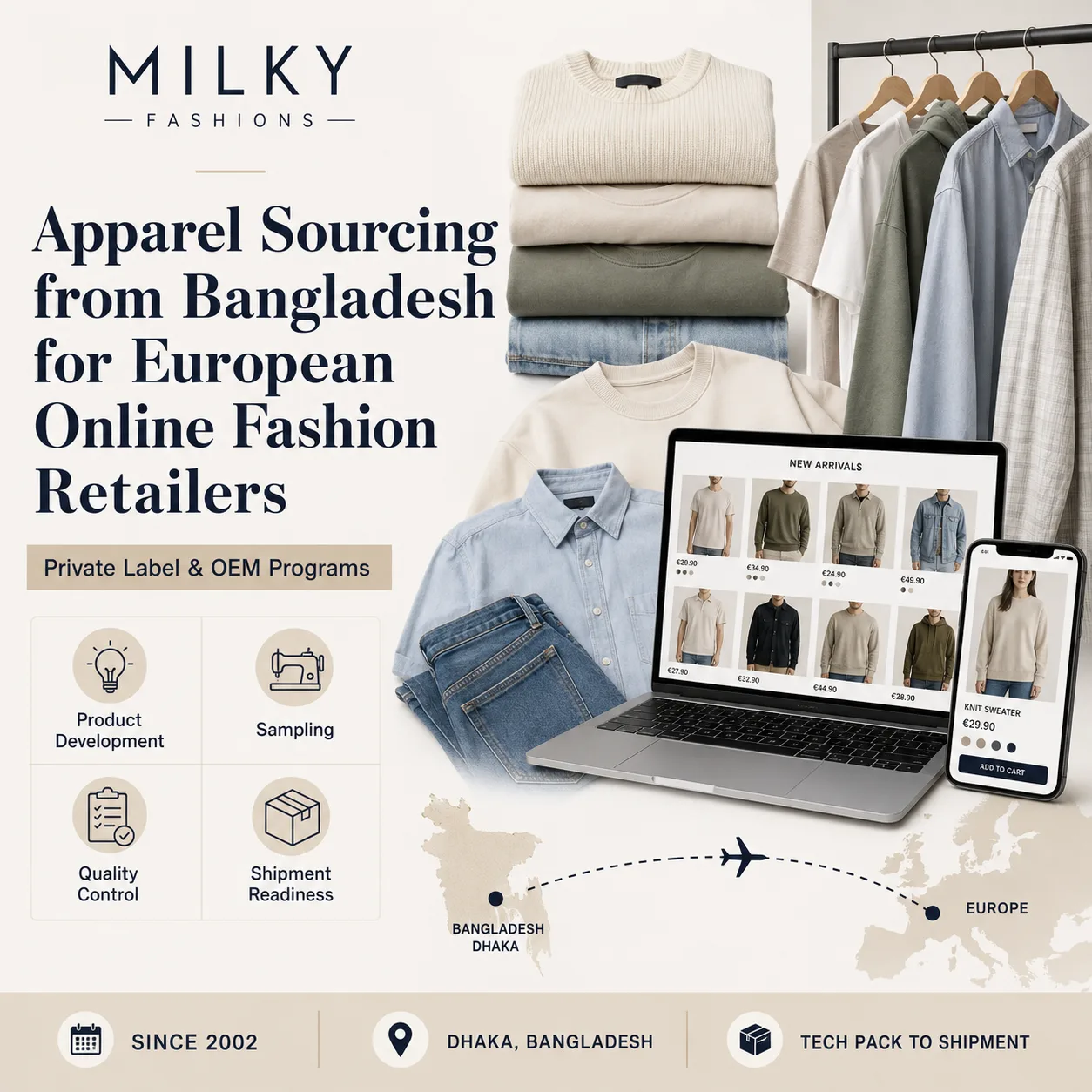
Clothing sourcing for online retail requires a different operating rhythm
Clothing sourcing from Bangladesh for European brands is not only a question of finding a factory that can make a garment. For an online fashion retailer, the sourcing path has to support a commercial calendar built around frequent product launches, multiple colours and sizes, fast approval cycles, consistent product information, and a clear handoff from production to the European warehouse. Bangladesh can fit this model when the product brief, factory route, compliance requirements, and shipment plan are aligned before bulk.
Milky Fashions is an independent apparel sourcing partner and garment buying house based in Dhaka, operating since 2002. We do not own factories. We coordinate private label and OEM apparel programs through partner factories selected for the actual product brief. For European online retailers, including Spanish fashion businesses, the practical value is one Dhaka-based coordination point for development, sampling, factory matching, production follow-up, quality checkpoints, and shipment readiness.
For an online retailer, the supply side has to support more than garment construction. Product consistency, launch timing, packaging accuracy, SKU information, and reliable approvals all affect whether a style is actually ready to go live. This is especially relevant for Spanish brands that may launch the same product online in Spain and later extend it into other EU markets.
Match the factory to the product, not the other way around
A common weakness in Bangladesh garment sourcing is starting with an available factory and forcing every style through the same route. That becomes risky when a retailer carries different product families, weights, constructions, washes, trims, and compliance requirements.
Milky Fashions approaches apparel sourcing in Bangladesh from the product brief first. A jersey T-shirt program, a heavyweight fleece hoodie, a flat knit cardigan, a denim bottom, and a woven fashion shirt do not automatically belong with the same production partner. The factory route should reflect machinery, fabric or yarn capability, finishing requirements, quality expectations, order structure, and the buyer's required documentation.
For online fashion retailers, assortment breadth can create hidden production complexity. A collection may look unified online while requiring several technical routes in Bangladesh. Our role is to keep those routes coordinated under one buyer-facing process.
Typical fashion categories that can be discussed with Milky Fashions include:
- T-shirts, polos, jersey tops, leggings, shorts, and casual basics
- Sweatshirts, hoodies, joggers, and fleece programs
- Sweaters, cardigans, and other flat knit products
- Woven shirts, dresses, trousers, shorts, and selected outerwear
- Denim jeans, jackets, skirts, and related casual products
- Kidswear and babywear when the brief and required factory route fit
A buyer searching for a Bangladesh clothing supplier for Europe should therefore look beyond a generic capability list. The better question is whether the sourcing partner can explain why a specific production route fits the style, and what needs to be confirmed before sampling and bulk booking.
Build the sourcing brief around the online launch calendar
Online retailers often work backwards from a campaign date, marketplace activation, or seasonal launch. That calendar should reach the sourcing team early because fit approvals, colour confirmation, packaging artwork, barcode data, and product information can all affect readiness.
A useful private label clothing Bangladesh brief should make the commercial and technical boundaries visible from the start, with enough detail for realistic factory matching and development.
| Buyer decision | Why it matters for online retail | What to provide |
|---|---|---|
| Product and construction | Determines the appropriate factory route | Tech pack, reference sample, sketches, construction notes |
| Fabric or yarn direction | Drives handfeel, appearance, testing, costing, and availability | Composition, weight, finish, colour direction, performance needs |
| SKU structure | Online ranges can multiply quickly across colour and size | Styles, colours, size range, planned quantity by option |
| Sample calendar | Delayed approvals can move the whole launch | Required sample stages, decision owners, target approval dates |
| Branding and packaging | Incorrect labels or packs create warehouse and listing problems | Main label, care label, hangtag, polybag, carton and barcode instructions |
| Compliance inputs | Requirements depend on the product and destination market | Buyer manual, testing requirements, restricted substance rules, audit requirements |
| Delivery plan | Production and logistics must work backwards from the selling date | Destination, requested ship window, launch date, preferred Incoterm |
For a Spanish retailer, the destination may be Spain, but the product can still be sold across several EU markets. The buyer should therefore define where the product will be placed on the market, which languages and labeling rules apply, and whether the same SKU is intended for multiple countries. Milky Fashions can coordinate factory-side documentation and production requirements named in the brief, while the buyer or its appointed compliance specialist remains responsible for determining the final legal requirements for each market.
This keeps the page separate from our Spain sourcing page, which owns Spain-specific sourcing intent. Here, the focus is the operating model needed by online fashion retailers.
Control samples, specifications, and bulk consistency before the problem scales
For apparel sourcing for online retailers, sampling is not a ceremonial step before production. It is where the buyer converts a design into a repeatable commercial product. Fit, measurements, fabric, colour, print or embroidery, trims, labeling, packing, and construction comments should be consolidated before bulk decisions are released.
Milky Fashions coordinates sampling communication between the buyer and selected partner factory so one current set of comments and approvals is maintained. Multiple versions of a tech pack, measurement chart, or trim instruction increase production risk.
A disciplined approval path should answer four questions before bulk:
- What exactly is approved?
- Which comments are still open?
- Who on the buyer side can close each decision?
- Does the factory have the same current specification that the buyer is using?
Quality control should follow the same logic. A final inspection is important, but it should not be the first moment that the buyer checks whether bulk production matches the approved standard. Practical Bangladesh clothing sourcing uses checkpoints during development and production so issues can be identified while corrective action is still possible.
For an e-commerce brand, consistency has a direct commercial effect. If the bulk garment changes materially from the approved sample, the issue can move into returns, complaints, and lost confidence in the product page. Specifications and approval discipline therefore matter as much as final inspection.
Prepare product information and EU requirements while the garment is being developed
European online retail adds a documentation layer that sourcing teams should not leave until goods are packed. Fibre composition, labels, responsible economic operator information where applicable, product identification, safety information, packaging data, and buyer-specific testing or chemical requirements need clear ownership.
For EU online retail, buyer teams should define the applicable fibre composition, product safety, traceability, and online product information requirements before bulk. The sourcing file and the product listing should not develop as separate projects. When the e-commerce team needs information that was never captured during development, avoidable gaps appear late in the process.
Milky Fashions does not claim that its own company holds factory certifications such as BSCI, GOTS, or OEKO-TEX. Where a program requires particular audit, certification, material, testing, or documentation conditions, we work through partner factories and suppliers whose suitability must be checked against the specific order and the buyer's current requirements.
For broader regulatory questions, buyers should use the relevant dedicated pages rather than treating this landing page as legal guidance. See our EU apparel compliance, EU textile regulations, and REACH and OEKO-TEX resources.
The practical principle is simple: define the evidence you need before selecting the factory. Requesting it after production starts is very different from screening the production route at the beginning.
Use a Dhaka sourcing partner when your team needs local coordination, not another sales layer
Some European brands prefer direct factory relationships. Others need a clothing sourcing partner in Bangladesh because the internal team does not have people on the ground to manage several suppliers. The right structure depends on internal sourcing capacity and program complexity.
Milky Fashions works as an independent garment buying house in Bangladesh. Buyer decisions remain with the brand. We coordinate the route in Bangladesh and keep the relevant factory, sample, production, and quality information moving toward those decisions.
This model can be useful when an online retailer has:
- Several product families that require different factory capabilities
- A European product team without a permanent Bangladesh office
- Seasonal and repeat styles running at the same time
- Multiple approval owners across design, merchandising, quality, and compliance
- A need for consolidated communication instead of separate factory follow-up
- Private label or OEM apparel Bangladesh programs that require development before bulk
Our broader garment sourcing services page explains the service itself. This page is narrower, addressing online fashion retail where assortment structure, product information, and launch timing create a different rhythm.
There are limits to what any sourcing partner can promise. Milky Fashions cannot responsibly guarantee a universal MOQ, the lowest market price, a fixed lead time for every garment, a particular tariff outcome, automatic certification acceptance, or a retailer's sell-through. Those outcomes depend on the product, material, order structure, selected factory, buyer requirements, current trade rules, approvals, and logistics. We prefer to review the actual brief and identify the workable route before making commercial commitments.
Start with the product brief, not a generic quotation request
If you are evaluating clothing sourcing from Bangladesh for European brands, start with a real product or collection. Send the category, tech pack or reference sample, fabric direction, quantity by style and colour, target market, required documents, and requested delivery window. For Spain, tell us whether the goods are for Spain only or wider EU distribution.
From there, Milky Fashions can review the sourcing path, identify the information still needed, and discuss suitable partner-factory options for the program. Costing and sampling are more meaningful once the product and order structure are clear.
For an online retailer, this approach also helps connect sourcing decisions to the commercial calendar. The same brief can establish what needs to be approved for production, what information the e-commerce team will eventually need, and where buyer decisions could delay the launch if they remain open.
WhatsApp is the fastest way to start. Share a brief or a short description of the range you are planning, and we can begin with the product category, quantity structure, sample status, destination market, and timing.
Frequently asked questions
How do European online fashion brands source clothing from Bangladesh?
A practical process starts with a clear product brief, tech pack or reference sample, fabric direction, quantity structure, target market and required delivery window. A sourcing partner can then identify suitable production routes, coordinate sampling, follow production and quality checkpoints, and prepare the order for shipment. The buyer keeps control of product, commercial and approval decisions.
Is Bangladesh suitable for European online fashion retailers?
Bangladesh can be suitable when the product category, quantity structure, factory capability, development calendar and buyer requirements are aligned. Online retailers should pay particular attention to SKU complexity, sample approvals, product consistency, packaging information and documentation because these factors affect both production and the eventual online launch.
What should we send Milky Fashions before requesting a quotation?
Send the product category, tech pack or reference garment, fabric or yarn specification where available, colour and size structure, expected quantity by style and colour, target market, branding and packaging requirements, required compliance documents and requested delivery window. A more complete brief allows a more meaningful factory and costing discussion.
Can Milky Fashions support Spanish online fashion retailers?
Yes. Milky Fashions can coordinate Bangladesh sourcing for Spanish brands, retailers and importers. If the same products will also be sold in other EU countries, the buyer should identify those markets during development so the relevant labeling, documentation, packaging and product information requirements can be considered from the beginning.
What is the minimum order quantity for clothing sourced from Bangladesh?
There is no responsible universal MOQ for every Bangladesh apparel program. Minimum quantities depend on the garment, fabric or yarn, colour structure, trims, finishing processes, factory setup and material availability. Milky Fashions reviews the actual brief before discussing what quantity structure may be workable with an appropriate partner factory.
How long does apparel production in Bangladesh take?
Production timing varies by product, material availability, sampling status, approvals, factory loading and shipment plan. Buyers should work backwards from the required launch or warehouse date and allow time for development and approvals before bulk production. Milky Fashions confirms the production path against the specific brief rather than promising one fixed lead time for every product.
Does Milky Fashions own garment factories in Bangladesh?
No. Milky Fashions is an independent apparel sourcing partner and garment buying house based in Dhaka. It works with partner factories and matches the production route to the buyer's product and requirements rather than presenting itself as the owner of a single manufacturing facility.
Does Milky Fashions itself hold BSCI, GOTS or OEKO-TEX certification?
No. Those certifications or audit schemes relate to factories, facilities, materials or supply-chain scopes as applicable. Milky Fashions works with partner factories and suppliers where relevant certifications or audit requirements can be checked against the buyer's program. Certificate availability and scope should be verified for the specific factory, material and order rather than assumed from a general capability statement.
Ready to discuss a sourcing brief?
For fashion brands, importers, and wholesale buyers. Share your product family, sample status, and market destination so we can prepare the next conversation.
Discuss your sourcing brief on WhatsApp