
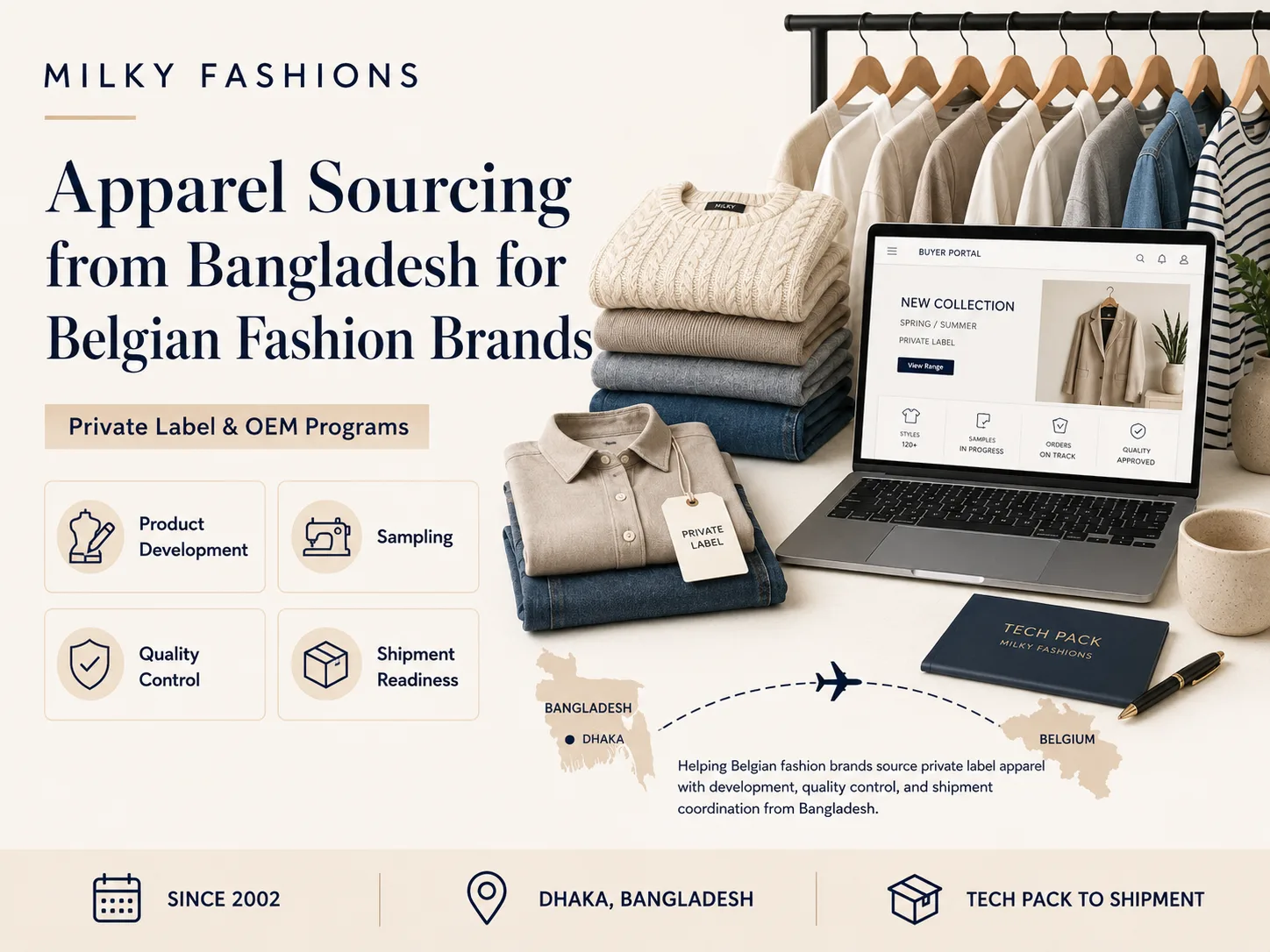
Apparel sourcing from Bangladesh for Belgian fashion brands works best when the production route is built around the buyer's actual product, compliance requirements, approval process and delivery plan. Belgian fashion brands, importers, wholesalers, sourcing managers and product developers can use Bangladesh for jersey, sweat products, sweaters, woven casualwear, denim, kidswear and other private label programs, but the right factory depends on the individual brief rather than a generic supplier list.
Milky Fashions is an independent apparel sourcing partner and garment buying house based in Dhaka, Bangladesh, working since 2002. We do not own factories. Instead, we coordinate product development, factory matching, sampling, production follow-up, quality checkpoints and shipment readiness through partner factories selected for the program. This distinction matters for Belgian buyers who need access to different production capabilities without forcing every category into one factory.
Bangladesh already has an established apparel trade with Belgium. Current BGMEA export data records both knit and woven garment shipments to the Belgian market, while the wider EU remains Bangladesh's most important apparel trading region. European Commission data also shows that textiles account for the overwhelming majority of EU imports from Bangladesh.
Match Belgian collections to the right Bangladesh production route
A buyer searching for a Bangladesh garment supplier for Belgium may initially look for one factory capable of producing the entire collection. In practice, fashion assortments often require several technical routes.
A heavyweight hoodie and a lightweight jersey T-shirt may both be knitted products, but their fabric development, machinery, finishing, washing and production requirements can differ. Flat knit sweaters belong to another manufacturing discipline. Denim, woven shirts and outerwear introduce further differences.
Milky Fashions therefore starts with the product brief rather than an available factory.
For Belgian fashion and wholesale programs, relevant sourcing categories can include:
- T-shirts, polos and jersey tops
- Sweatshirts, hoodies and joggers
- Casual jersey bottoms and shorts
- Sweaters, cardigans and other flat knit products
- Woven shirts and blouses
- Dresses, trousers and casual woven products
- Denim jeans, jackets and related products
- Selected outerwear
- Kidswear and babywear where the required production and compliance route is suitable
- Private label and OEM apparel programs
Bangladesh's export base is particularly established across trousers, T-shirts and knitted shirts, sweaters, shirts and blouses, and underwear, according to BGMEA's product-level export reporting.
That breadth is one reason buyers searching for Bangladesh apparel sourcing often encounter suppliers promoting every possible garment category. Capability lists alone, however, are not enough. The sourcing decision should consider fabric or yarn capability, garment construction, finishing processes, machinery, compliance requirements, order structure and the factory's experience with the relevant product type.
For example, a Belgian brand developing a 100 percent cotton jersey collection may need a different factory route from a buyer sourcing engineered jacquard sweaters or washed denim. The objective is not to find the biggest supplier. It is to find a production setup that fits the program.
Our category-specific pages, including knitwear sourcing from Bangladesh, denim sourcing, T-shirt sourcing and sweater and cardigan sourcing, provide more detailed product information.
A sourcing partner is different from a single clothing manufacturer
Search results for terms such as clothing manufacturer Bangladesh Belgium, private label clothing manufacturer Bangladesh and OEM clothing manufacturer Bangladesh often mix factories, exporters, buying houses and sourcing companies together.
They are not the same operating model.
A factory primarily sells the production capability available within its facility. An apparel sourcing partner in Bangladesh can evaluate the brief across several possible production partners and coordinate the selected route on the buyer's behalf.
Milky Fashions operates under the second model.
The Belgian buyer keeps control of product direction, specifications, approvals and commercial decisions. Milky Fashions provides the Bangladesh-side coordination needed to move those decisions through development and production.
The process can include:
- Reviewing the product category, tech pack or reference sample.
- Identifying the most appropriate partner-factory route.
- Coordinating material and sample development.
- Consolidating buyer comments and approvals.
- Following production against the agreed specification.
- Arranging quality checkpoints during the production cycle.
- Coordinating packing and shipment-readiness information.
This structure can be particularly useful for a Belgian importer or fashion business sourcing several categories. Rather than managing a jersey factory, sweater factory and woven factory through separate communication channels, the buyer can maintain one Bangladesh sourcing coordination point.
Our broader garment sourcing Bangladesh page explains the general sourcing model, while the garment buying house Bangladesh page explains the buying-house structure in more detail. This Belgium page remains focused specifically on Belgian buyer requirements rather than repeating those head-term topics.
Build a Belgium-ready sourcing brief before requesting prices
Costing becomes more meaningful when the supplier receives enough information to understand the product.
A request that says "100 percent cotton T-shirt for Belgium" leaves important variables unanswered. Fabric weight, yarn quality, construction, wash, colour count, print, embroidery, trims, labels, packaging, testing and quantity structure can all affect the production route.
For private label clothing Bangladesh programs, Belgian buyers should ideally prepare a sourcing brief that connects the commercial requirement to the technical specification.
| Brief item | What the Belgian buyer should provide | Why it matters |
|---|---|---|
| Product | Tech pack, sketch, reference garment or clear description | Establishes construction and development requirements |
| Fabric or yarn | Composition, weight, structure, finish and performance requirements | Guides material sourcing and factory selection |
| Order structure | Quantity by style, colour and size | Helps assess whether the program fits the production route |
| Branding | Main label, size label, care label, hangtag and trim requirements | Affects development and approval work |
| Decoration | Print, embroidery, wash or other treatment | Can require specialist processing |
| Packaging | Folding, polybag, barcode, carton and retail requirements | Needs approval before packing |
| Compliance | Required audits, certifications, tests and buyer standards | Must be considered during supplier selection |
| Destination | Belgium only or wider EU distribution | Influences labelling and documentation planning |
| Timing | Required launch, warehouse or shipment window | Allows the production calendar to be assessed realistically |
A sourcing manager should also identify who owns approvals on the buyer side. When design, merchandising, product development and compliance teams issue separate comments, the factory can receive conflicting instructions.
One controlled version of the tech pack, measurement chart and sample comments is much safer.
The same discipline applies after sampling. Fabric quality, colour, fit, construction, trims and packaging should be clearly approved or marked as outstanding before bulk production decisions are made.
This is an area where a garment buying house in Bangladesh can add practical value. The task is not simply forwarding emails between Belgium and a factory. It is maintaining a clear sequence of decisions so the production team knows what is approved and what is still open.
Plan EU compliance and Belgian textile labelling before bulk production
Belgian apparel buyers operate inside the EU regulatory framework, but Belgium also has national language considerations that make early label planning important.
EU Regulation 1007/2011 requires textile products placed on the market to carry information about their fibre composition. The information must be durable, legible, visible and accessible. The regulation also limits which fibre names may be used and sets rules for describing products containing multiple fibres.
Belgium's Federal Public Service Economy provides corresponding guidance for textile products and states that regulated labelling must at least use a language understandable to the average consumer, taking account of the language region where the goods are offered. Belgian brands selling across different parts of the country should therefore establish the required consumer-facing language treatment before labels are ordered in bulk.
For online sales, EU textile rules also require fibre-composition information to be clearly visible to the consumer before purchase.
These requirements are one reason compliance inputs should be part of product development rather than an exercise performed after production.
A Belgian buyer should communicate applicable requirements for:
- Fibre composition
- Label language
- Care and brand labels
- Product identification
- Chemical and restricted-substance requirements
- Testing
- Social compliance requirements
- Packaging
- Traceability documentation
- Any buyer-specific supplier manuals
Milky Fashions does not itself hold factory certifications such as BSCI, GOTS or OEKO-TEX, and we do not present those certifications as Milky Fashions company certificates. Where a program requires particular audits, certified materials or standards, the relevant partner factory, supplier and certificate scope must be checked against the actual order.
Buyers needing more detail should use our dedicated EU apparel compliance, EU textile regulations, factory certifications and REACH and OEKO-TEX pages. The purpose here is to make clear that Belgium-specific sourcing should incorporate those requirements from the beginning, not duplicate the compliance guidance.
Evaluate cost, quantities, timing and trade terms against the actual program
High-intent searches such as clothing supplier Bangladesh for Europe, garment sourcing Bangladesh and private label clothing Bangladesh Belgium often lead to pages advertising universal MOQs, fixed production times or guaranteed prices.
Those promises should be treated carefully.
Garment costing depends on variables including fabric or yarn, construction, garment weight, trims, finishing, decoration, order quantity and colour breakdown. Production timing also depends on material readiness, sample approvals, factory loading, testing requirements and the specific product.
For that reason, Milky Fashions does not use one fixed MOQ, garment price or lead time as a promise for every Belgian sourcing enquiry. We review the product and order structure first.
The same caution applies to landed-cost assumptions.
Bangladesh currently benefits from preferential EU market access under the Everything But Arms arrangement. Bangladesh is presently scheduled by the United Nations to graduate from Least Developed Country status, although the graduation timetable has been under active review in 2026. The EU's renewed Generalised Scheme of Preferences provides for continued EBA preferences for Bangladesh for a transition period after graduation. Buyers placing future orders should therefore verify the rules and tariff treatment applicable when goods are imported rather than relying on an old sourcing quotation or a permanent "zero duty" website claim.
Our Bangladesh LDC graduation page covers that topic separately.
Incoterms also need to be stated clearly. FOB, CIF and other structures allocate different responsibilities and costs between seller and buyer. Belgian importers should establish their preferred commercial route before finalising the order and freight plan. Our Incoterms guide for apparel sourcing covers that distinction in greater depth.
There is an important limit to what this page can promise. No sourcing partner can responsibly guarantee that every product, factory, quantity, price, compliance requirement or delivery window will be workable before reviewing the actual brief. Regulations, factory availability, materials and trade conditions can also change. The appropriate sourcing route should therefore be confirmed program by program.
Start with a real Belgian apparel sourcing brief
If you are evaluating apparel sourcing from Bangladesh for Belgian fashion brands, the most useful first step is not a generic request for a supplier list.
Send the product information.
A Belgian fashion brand, importer, wholesaler, sourcing manager or product developer can share a tech pack, reference garment, sketch or existing specification together with the intended quantity structure, target market, fabric direction and timing.
Milky Fashions can then review the brief from Dhaka, identify the production capabilities required and discuss which partner-factory route may be appropriate.
This is the practical role of a Bangladesh apparel sourcing partner: connect the buyer's product requirement with the right production path while keeping development, samples, quality follow-up and shipment readiness coordinated.
If your collection is intended for Belgium and other EU markets, mention those destinations from the start so labelling, documentation and buyer requirements can be considered during development.
For the fastest initial discussion, send the sourcing brief through WhatsApp. A tech pack is ideal, but if development is still early, start with the product category, reference images, approximate order structure and target market.
Frequently asked questions
Can Belgian fashion brands source clothing from Bangladesh through Milky Fashions?
Yes. Milky Fashions supports Belgian fashion brands, importers, wholesalers, sourcing managers and product developers that want to develop and source apparel through Bangladesh partner factories. We work as an independent sourcing partner and buying house rather than a factory owner, coordinating the production route from the brief through sampling, production follow-up, quality checkpoints and shipment readiness.
What clothing categories can be sourced from Bangladesh for Belgium?
Potential categories include T-shirts, polos, jersey products, hoodies, sweatshirts, joggers, sweaters, cardigans, woven shirts, trousers, dresses, denim, selected outerwear, kidswear and babywear. Factory selection depends on the construction, fabric or yarn, finishing requirements, quantity structure and buyer compliance requirements of the individual program.
Is Milky Fashions a clothing manufacturer in Bangladesh?
No. Milky Fashions is an independent apparel sourcing partner and garment buying house based in Dhaka. We do not own factories. We match suitable partner factories to the buyer's product brief and coordinate development, sampling, production follow-up, quality control and shipment readiness.
Can Milky Fashions support private label and OEM clothing for Belgian brands?
Yes. Private label and OEM apparel programs can be coordinated through appropriate partner factories. Buyers should provide the product specification, branding requirements, fabric or yarn direction, quantity structure, packaging requirements and target market so the production route can be assessed against the actual brief.
What is the MOQ for sourcing garments from Bangladesh for Belgium?
There is no single MOQ that applies to every product. Workable quantities depend on the garment category, material, colour breakdown, trims, processing, factory setup and material minimums. Milky Fashions reviews the product and order structure before discussing an appropriate production route rather than publishing one universal MOQ.
How long does garment production in Bangladesh take for Belgian buyers?
Timing depends on the product, material availability, development status, sample approvals, testing, factory loading and shipment plan. A realistic calendar should be built backwards from the required warehouse or launch date after the actual product brief has been reviewed.
What textile labelling should Belgian apparel buyers consider?
EU textile rules require fibre-composition information to meet Regulation 1007/2011. Belgium also applies language requirements that take account of the language region where goods are offered to consumers. Belgian buyers should define the markets and required consumer-facing label information before bulk labels and packaging are produced.
Do Milky Fashions partner factories have BSCI, GOTS or OEKO-TEX certification?
Certification requirements are checked at the partner-factory or material-supplier level for the specific sourcing program. Milky Fashions itself does not claim BSCI, GOTS or OEKO-TEX certification. Where a Belgian buyer requires a particular audit, certification or transaction document, its validity and scope should be verified for the relevant factory, supplier, material and order.
What should a Belgian buyer send to start a Bangladesh sourcing enquiry?
Ideally send a tech pack or reference garment together with the product category, fabric or yarn specification, colour and size structure, expected quantities, branding and packaging requirements, target market and required timing. If the product is still at concept stage, reference images and a clear description are enough to begin an initial sourcing discussion through WhatsApp.
Ready to discuss a sourcing brief?
For fashion brands, importers, and wholesale buyers. Share your product family, sample status, and market destination so we can prepare the next conversation.
Discuss your sourcing brief on WhatsApp