
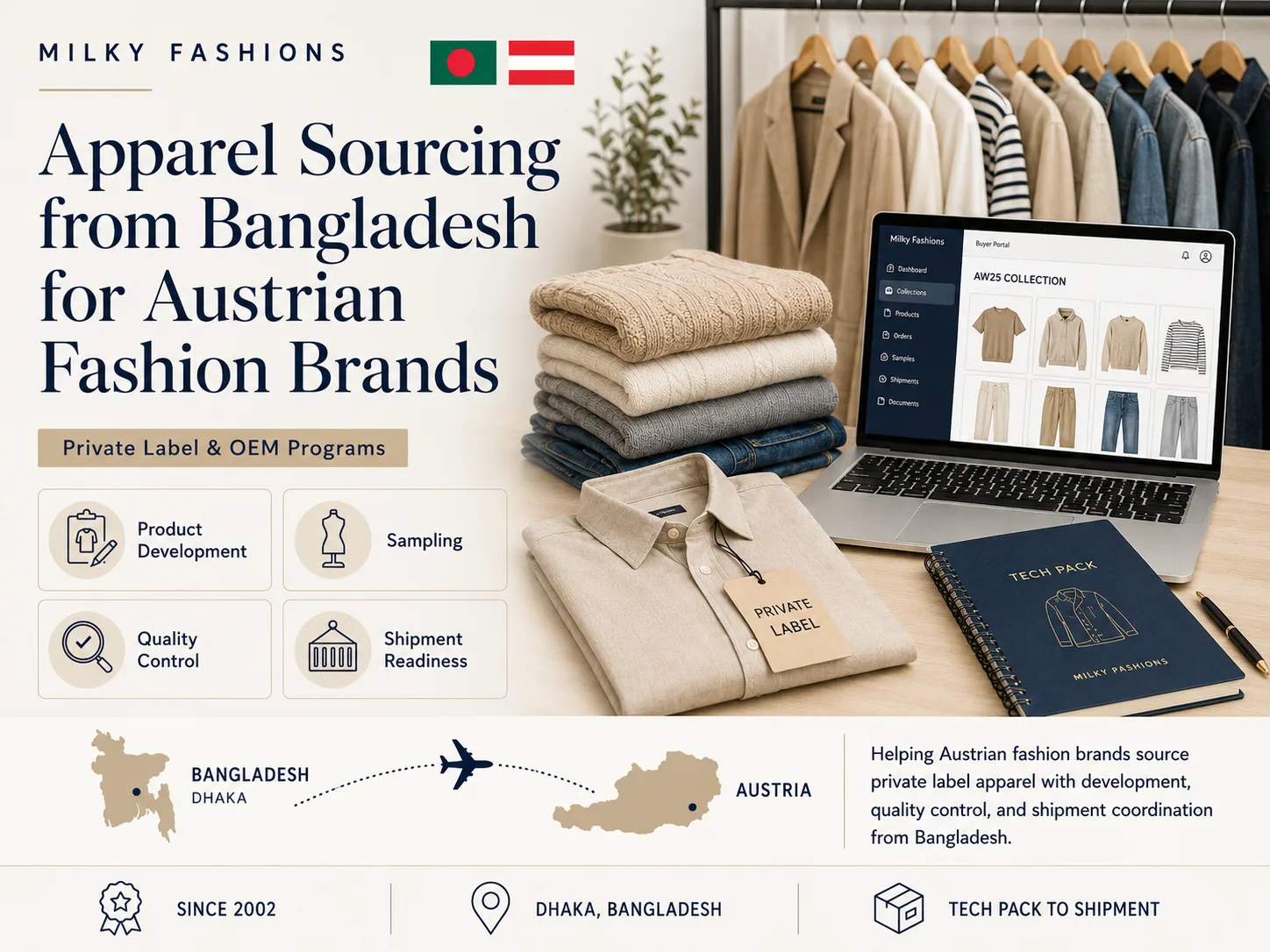
Apparel Sourcing Bangladesh Austria: A Buyer-Controlled Route
Austrian fashion brands sourcing from Bangladesh need more than a factory list. They need the right production unit for the product, a controlled sample and approval process, clear quality checkpoints, and documents that support import and sale in Austria. Milky Fashions is an independent apparel sourcing partner and garment buying house in Bangladesh, based in Dhaka and established in 2002. We coordinate partner factory selection, product development, sampling, production follow-up, quality control, compliance evidence, and export documentation around the buyer's approved brief.
This page is for Austrian fashion brands, importers, wholesalers, merchandisers, and product developers evaluating apparel sourcing from Bangladesh. It explains where Bangladesh can fit, what an Austrian buyer should confirm before placing an order, and how Milky Fashions keeps decisions with the buyer. We do not own factories or present partner factory certificates as our own. The starting point is always the product, quantity range, construction, target market, required evidence, and delivery plan.
Bangladesh has an established export base across knit and woven apparel. Current BGMEA export reporting records both categories moving from Bangladesh to Austria. The opportunity is practical when a collection can be matched to a factory with the right machinery, material experience, compliance profile, and commercially workable order size.
For an Austrian buyer, the value is not simply a low unit price. A quotation only becomes useful when fabric composition, weight, wash, trims, workmanship, packing, testing, approvals, Incoterm, and order quantity are defined on the same basis. A price that excludes important requirements is not comparable with a complete quotation. Our broader garment sourcing services for European apparel buyers explain the coordination role across these stages.
Bangladesh is widely used for jersey basics, sweats, hoodies, polos, flat knit sweaters and cardigans, shirts, trousers, denim, dresses, outerwear, underwear, and children's clothing. That does not mean every factory is suitable for every style. An Austrian label developing fine-gauge knitwear needs a different production setup from an importer buying printed jersey basics or a wholesaler building a mixed woven range.
This distinction matters when buyers search for a clothing supplier in Bangladesh for Austria, a Bangladesh apparel supplier for Austrian brands, or an OEM clothing supplier in Bangladesh for Austria. The more useful question is: which production setup can execute this exact brief, at the required quantity and evidence level, without creating avoidable development risk?
A Sourcing Partner Is Different From a Single Factory
A factory manufactures within its own technical and capacity profile. A sourcing partner starts with the buyer's requirement and assesses which factory profile fits it. Milky Fashions operates as an independent buyer-controlled sourcing model, not as a factory owner. This allows factory selection to consider product category, fabric or yarn route, machinery, workmanship, order size, audit status, certification scope, testing needs, and production timing.
For garment sourcing in Bangladesh for Austrian brands, our practical role can include:
- reviewing the tech pack, reference sample, bill of materials, and measurement chart;
- identifying missing information before factories quote;
- approaching partner factories that fit the product and programme;
- comparing quotations on a consistent commercial basis;
- coordinating proto, fit, size-set, pre-production, and other samples required by the buyer;
- maintaining approval records and communicating revisions;
- following the production critical path and reporting exceptions;
- arranging in-line and final quality checks against the buyer's instructions;
- collecting the agreed factory, material, testing, and shipment documents; and
- coordinating with the buyer's nominated logistics parties for export readiness.
The buyer retains approval authority. Fabric, colour, fit, workmanship, packaging, production release, inspection disposition, and shipment approval should not be assumed. Our garment sample development process shows why approved samples and comments must stay connected to the final production specification.
Product Categories and Factory Matching
Milky Fashions can coordinate private label and OEM apparel across jersey, flat knit, woven, denim, outerwear, underwear, and children's categories, subject to the brief and a suitable partner factory. For private label clothing from Bangladesh to Austria, the factory decision should be made after the product requirements are clear, not before.
Jersey programmes may include T-shirts, polos, sweatshirts, hoodies, joggers, leggings, shorts, and pyjamas. The buyer should define fabric composition, structure, finished weight, surface finish, colour standard, dimensional stability requirements, and decoration method. Flat knit programmes need yarn composition, gauge, stitch structure, garment weight or measurement detail, linking requirements, and finishing expectations. Woven and denim programmes depend on fabric construction, wash route, garment engineering, trims, and measurement control. Outerwear adds component, performance, and testing questions that should be settled early.
A product-family match is only the first filter. The same factory may be commercially suitable for one order but unsuitable for another because the quantity, material minimums, embellishment, testing, or delivery window differs. For sustainable apparel sourcing from Bangladesh to Austria, the buyer must also define what “sustainable” means for that programme. It may require certified organic content, recycled content, restricted-substance controls, social audit evidence, traceability records, or a combination of these.
Our factory certification guidance explains the evidence distinctions. Milky Fashions can work with partner factories holding relevant certifications or audit records, but applicability and validity must be checked for the selected facility, product, material, process, and order. Amfori states that BSCI is not a certification, and Sedex says the same of SMETA audits. GOTS programmes may require valid scope and transaction certificates, while OEKO-TEX STANDARD 100 applies to tested textile articles within a certificate's scope.
Austria and EU Readiness Before the Purchase Order
Austria applies EU product rules, while the Austrian importer or brand must also consider national implementation, language, packaging, consumer information, and enforcement expectations. Product readiness should therefore be planned before sampling is closed.
EU Regulation 1007/2011 requires textile fibre composition labelling for covered products. European Commission guidance says the information must be in the official language of the member state where the product is offered to consumers. For Austria, German consumer-facing information should therefore be planned and approved, unless the buyer's qualified adviser confirms an applicable exception. The Austrian Federal Economic Chamber also reminds manufacturers, importers, and traders of their responsibility for correct textile labelling.
The General Product Safety Regulation, Regulation (EU) 2023/988, has applied since 13 December 2024. It strengthens product safety, traceability, risk assessment, technical documentation, and economic operator responsibilities for consumer products. Apparel may also be affected by REACH chemical restrictions, category-specific safety concerns, and buyer restricted substance lists. The detailed legal assessment belongs to the responsible Austrian or EU economic operator, but the sourcing file should make required evidence visible.
| Buyer control point | What should be confirmed before bulk | What Milky Fashions can coordinate |
|---|---|---|
| Product specification | Construction, measurements, fibre content, colour, wash, trims, performance, intended user | Clarifications, factory feedback, sample revisions, and approval tracking |
| Factory evidence | Correct facility identity, current audit status, required certification scope, approved subcontracting | Document requests and buyer review file for the selected partner factory |
| Material claims | Evidence for organic, recycled, or other claimed content | Supplier document collection and transaction evidence where the programme requires it |
| Austrian labels | German fibre information, care and size details, responsible operator information, barcode and retail copy | Artwork routing, pre-production checks, and approved label version control |
| Chemical and safety requirements | Buyer RSL, REACH checks, risk assessment, testing protocol, children's product details where relevant | Test sample coordination and report collection through agreed laboratories or suppliers |
| Packaging | Packing method, material specification, markings, Austria packaging obligations, retailer requirements | Packing approval records and packaging data requested in the brief |
| Customs and origin | Commodity code, declared origin, proof of origin, valuation, Incoterm, importer instructions | Export document coordination based on approved commercial terms |
| Quality release | AQL or buyer inspection standard, defect classifications, measurement tolerances, shipment decision | In-line and final inspection reporting for buyer disposition |
For broader requirements, use our EU apparel compliance overview and the focused guide to REACH and OEKO-TEX in apparel sourcing. Those resources own the detailed compliance intent. This Austria page stays focused on how Austrian buying teams should build those requirements into a Bangladesh sourcing brief.
A Buyer-Controlled Process From Brief to Shipment
1. Define the commercial and technical brief
Send the tech pack or clear product references, quantity by style and colour, size range, material specification, target quality level, destination, required certifications or audits, testing protocol, packaging needs, and requested delivery timing. If the range is still being developed, identify which information is provisional. A Bangladesh garment exporter quoting an incomplete request may make assumptions that later change the cost or production route.
2. Check feasibility before comparing prices
We review the brief, raise missing points, and approach suitable partner factories. Commercial feasibility includes material minimums, dyeing or yarn constraints, print and embroidery setup, washing, specialised trims, testing, packing, and available production windows. An apparel sourcing partner in Bangladesh should show what the quotation assumes so the Austrian buyer can compare like with like.
3. Develop and approve samples
Sampling should answer specific questions at each stage. The first sample may test shape and construction. Later samples may confirm fit, graded measurements, colour, material, decoration, trims, labels, packing, and bulk readiness. Buyer comments must be measurable and linked to the correct sample version. Before production release, use a disciplined pre-production approval checklist to close open points.
4. Control production against the approved standard
After approvals and commercial confirmation, the selected factory books materials and schedules production. Milky Fashions follows agreed milestones, communicates exceptions, and coordinates quality checks. Inspection does not replace prevention. Fabric, measurements, workmanship, shade, decoration, labels, and packaging should be controlled during production so that final inspection is not the first time a material issue appears.
5. Prepare shipment and document handover
The buyer or importer should confirm the commodity code, customs treatment, Incoterm, forwarding instruction, destination details, and documents needed for clearance. Milky Fashions coordinates the supplier-side export file and inspection records according to the agreed order. If you plan to import garments from Bangladesh to Austria, align the purchase order, invoice, packing list, origin evidence, transport document, and product description before cargo handover.
Cost, MOQ, Lead Time, and Logistics Need a Real Brief
There is no responsible universal price, MOQ, or lead time for apparel sourcing from Bangladesh for Austria. These depend on the product, material, colour count, construction, decoration, trim development, testing, packaging, order allocation, factory setup, and production season. A basic jersey item using an available material route has a different commercial structure from a custom yarn-dyed sweater, washed denim style, or technical outerwear product.
MOQ should be explained by its constraint. Fabric knitting and dyeing, yarn purchase, colour minimums, trim supplier minimums, print setup, washing batches, and line economics may each create a different threshold. Where a lower quantity is technically possible, it may require a different material route, colour plan, factory, or cost. Milky Fashions confirms project-specific feasibility rather than advertising one number for every category.
Lead time should be built backward from the required arrival date. It can include clarification, costing, material development, sampling, approval cycles, raw material booking, production, inspection, export handover, international transport, customs clearance, and delivery inside Austria. Our Bangladesh garment lead-time planning guide covers the critical path in more detail.
Austria is landlocked, so the practical route may combine ocean or air transport with onward European movement. The right entry point and responsibility split depend on the forwarder, shipment size, delivery location, Incoterm, and buyer's customs setup. Milky Fashions does not promise a fixed route or duty outcome. Buyers comparing FOB, CIF, and other structures can use our apparel sourcing Incoterms guide before agreeing the quotation basis.
Bangladesh is scheduled by the United Nations to graduate from least developed country status on 24 November 2026. Buyers should not assume that today's tariff treatment will remain unchanged throughout a future programme. Check the commodity code, origin rule, proof requirements, shipment timing, and applicable preference in the European Commission's Access2Markets system. Our Bangladesh LDC graduation briefing provides the sourcing context without promising a particular duty result.
When Milky Fashions Is the Right Fit
Milky Fashions is relevant when an Austrian brand, importer, or wholesaler wants a Dhaka-based team to coordinate factory matching, samples, approvals, production follow-up, quality checks, and supplier-side documentation while keeping buyer decisions visible. The model is useful for private label clothing, OEM apparel, repeat programmes, and multi-category sourcing where a single factory may not be the best answer for every product.
This page cannot promise that every design, quantity, target price, certification request, or delivery date will be feasible. Milky Fashions does not own factories, does not hold partner factory certificates in its own name, and cannot replace the Austrian importer's legal, customs, tax, product safety, or environmental advisers. Factory availability, evidence, costing, minimums, and timing are confirmed only after reviewing the actual brief.
To discuss apparel sourcing from Bangladesh for your Austrian market, send your product type, tech pack or reference, quantity range, required evidence, target timing, and delivery basis through WhatsApp. We will review the brief and confirm the practical next step.
Frequently asked questions
How does garment sourcing from Bangladesh to Austria work?
The buyer shares a technical and commercial brief, including the product, quantities, materials, quality requirements, evidence needs, packaging, destination, and timing. Milky Fashions reviews feasibility, matches the brief with suitable partner factories, coordinates quotations and samples, follows production, arranges agreed quality checks, and collects supplier-side documents. The Austrian buyer keeps approval authority throughout the programme.
Is Milky Fashions a clothing manufacturer or factory owner?
No. Milky Fashions is an independent apparel sourcing partner and garment buying house based in Dhaka. It works with partner factories selected according to the product, quantity, technical needs, compliance requirements, and production timing. Factory certificates and audit records belong to the relevant facilities and must be checked for scope and validity.
What garments can Austrian buyers source through Milky Fashions?
Subject to the brief and a suitable factory match, programmes may cover jersey garments, T-shirts, polos, sweats, hoodies, joggers, flat knit sweaters and cardigans, shirts, trousers, denim, dresses, outerwear, underwear, children's clothing, and related private label ranges. Feasibility is confirmed style by style because materials, construction, processes, and quantities differ.
Can you support private label clothing from Bangladesh to Austria?
Yes, Milky Fashions can coordinate private label and OEM programmes using the buyer's designs, tech packs, branding, label artwork, packaging instructions, and approval standards. The exact development route depends on how complete the brief is and whether custom fabrics, yarns, washes, prints, embroidery, trims, or testing are required.
Which factory certifications and audit records can be requested?
The required evidence depends on the buyer and product. Relevant partner factories may hold records or certifications connected with amfori BSCI, Sedex or SMETA, WRAP, GOTS, GRS, or OEKO-TEX. These terms are not interchangeable. For example, amfori BSCI is not a certification, and GOTS claims may require both valid scope and transaction documentation. Milky Fashions requests evidence for buyer review rather than claiming it as its own.
What MOQ and lead time should an Austrian buyer expect?
There is no single honest MOQ or lead time for every garment. Both depend on material minimums, colour count, construction, decoration, trims, washing, testing, packaging, factory setup, production season, and approval speed. After reviewing the actual brief, Milky Fashions can confirm feasible factory options and the assumptions behind each quotation and timeline.
What product information is needed for selling clothing in Austria?
The Austrian buyer should confirm textile fibre labelling, German-language consumer information, product safety and traceability requirements, REACH and restricted-substance expectations, packaging obligations, responsible economic operator details, and any category-specific rules. Milky Fashions can coordinate approved labels, test samples, and supplier documents, but the responsible Austrian or EU operator should approve legal compliance.
Can Milky Fashions act as a garment buying house in Bangladesh for Austria?
Yes. Milky Fashions is an independent garment buying house and sourcing partner based in Dhaka, not a factory owner. It can coordinate factory matching, quotations, samples, approvals, production follow-up, quality checks, compliance document collection, and export readiness while the Austrian buyer retains approval authority. Suitability is confirmed only after the actual programme brief is reviewed.
How can an Austrian buyer request a sourcing review?
Send the product category, tech pack or clear reference, quantity by style and colour, material requirements, required factory evidence, testing needs, target timing, delivery location, and preferred commercial basis through WhatsApp. Milky Fashions will review the information, identify missing points, and confirm whether a suitable sourcing route can be explored.
Ready to discuss a sourcing brief?
For fashion brands, importers, and wholesale buyers. Share your product family, sample status, and market destination so we can prepare the next conversation.
Discuss your sourcing brief on WhatsApp